In earlier times, people of faith readily affirmed the concept of conversing with a Higher Power, who was called by different names in various languages around the world. Today, even those who follow faith traditions are less certain what conversation with God means in practice; and those who doubt the spiritual dimension consider such conversation purely imaginary. Yet prayer, and hearing back from God, is at the heart of spirituality, so ignoring this mystery comes at great expense.
I grew up in a family where talking to God was entirely natural. When I left my faith in my late teens, I joined the modern mindset in scoffing at such primitive ways. After espousing materialistic atheism for a few years at Harvard, I gradually found myself growing curious about fields beyond a material dimension, such as ESP, and other paranormal phenomena. With others of my generation I was intrigued by eastern religions, which seemingly dispensed with a monotheistic God and god-given moral codes.
I will not repeat here how my meanderings led me eventually back to my Judeo Christian heritage, since I have told this story before. But although I now worship the God of my ancestors, my concept of God and the possibility of conversation have been immensely expanded.
I realize how foolish it is for a tiny human speck living on one of the many billions of planets to believe that we have the standing to talk with God from any point of even remote equality. The Old Testament accounts of Abraham, Moses and David arguing with God worked a lot better when God was conceived as a planetary deity, far greater than an earthly king, but at least remotely related to our scale.
Now that our concept of God has been expanded necessarily by a billion times, we wonder how we could conceivably relate to such a Supreme Being. It is not surprising that so many moderns have simplified this issue by dismissing the God concept entirely. Regrettably, I don’t have irrefutable arguments for the determined skeptic. But I have some hints for curious-minded souls.
I start with the observation that people in nearly every culture and time have had some concept and practice of prayer. While these phenomena can be dismissed as primitive, the arrogant assertions of unique brilliance of the 21st century mind are not supported by observation. Architecture and engineering in ancient Egypt and Greece were clearly world class by any standard. There is little reason to believe that philosophers, poets and theologians who lived in the past 3,000 years were inferior to us, except in population numbers. We are not appreciably smarter; we are just more numerous than our ancestors.
Most religious traditions have affirmed prayer both as spoken words and also as silent thoughts offered up to God. While there have been sporadic reports through the centuries of God speaking to us in direct audible speech, the general tendency is to hear His Voice as the thoughts we receive, or by surprising events.
Dialing into the thoughts of God is not as superstitious as some might suspect. Albert Einstein, the greatest scientist in recent centuries, considered God’s thoughts to be an incomparable treasure trove. So did the ancient writers of the Psalms.
We do not easily tune into the thoughts of God. Spiritual training, discipline and introspection are needed to discern God’s voice. And yet, a little child knows clearly at times what God wants.
God is the ultimate source of all brilliant thought and invention, whether or not the person so inspired knows, or gives credit to God. We can train our minds and hearts for better reception, but all of humanity receives this gift of occasional inspired thinking, unless we destroy our minds.
I will not digress here to consider the source of evil thoughts and impulses to action, which is another topic.
The practical question many would ask is: if we pray for a specific request, will God answer? Unfortunately, the answer is an unqualified “maybe.” God hears our every thought, prayer, or curse. But God responds in surprisingly diverse ways.
I have taken vexing questions and situations to God and at times received quick answers, which seemed miraculous. Millions of others testify to such results. But countless prayers also seem to go unanswered for reasons that theologians cannot explain. God always hears, but His decision-making is incomprehensible to our minuscule minds.
God can never be manipulated to suit our purposes, whether by the unscrupulous, or even by those who live according to His Will. Sometimes the upright petitioner seems rejected, and sometimes the scoundrel receives a miracle. God does not play according to our rules!
Climbing the Spiritual Mountain
Almost every culture has used the metaphor of a mountain to symbolize our spiritual journey. In reality, spiritual people do not need to enroll in actual mountain climbing expeditions. But they do need to prepare for an arduous, life-changing journey.
The mountain climb consists of relationship building and of character transformation. To relate well to such an infinite God is markedly demanding. The relationship building is not only upward to God, but also in relating honestly and kindly to all of humanity. These two types of relationships cannot be successfully separated.
Jesus summarized the spiritual journey as loving God with all our heart, soul, mind, and strength, and loving our neighbour as ourselves. That is the foundation of spiritual relationship. This involves making God the center of our entire universe, which is harder than it would seem. But the rewards are heavenly.
We can gradually bring our lives and thoughts into the presence of God by making Him the center of our consciousness. Every action and every breath we take can become part of our unending conversation with our Creator. This is the meaning of “praying without ceasing” as enjoined by St. Paul.
True spirituality practiced for a lifetime leads us to becoming friends with God, as incredible as this may be. In one sense. God is already the Friend of all who seek Him, but this is not their conscious experience moment by moment. In fact, I have not met anyone who lives so far up the mountain that they are God-conscious at every waking moment. But I believe that such a high spiritual altitude may be attainable. That is likely the place Moses and the other spiritual giants of the past lived.
God invites us daily to conversation: through the exquisite beauty of trees, ocean and mountains; by celestial music; by transcendent artistic creation; by all growing things; through the unexpected kindness of a stranger; and, by the ineffable beauty of daily life. There is no better friendship or conversation than this.
Tuesday, January 18, 2011


Friday, July 23, 2010
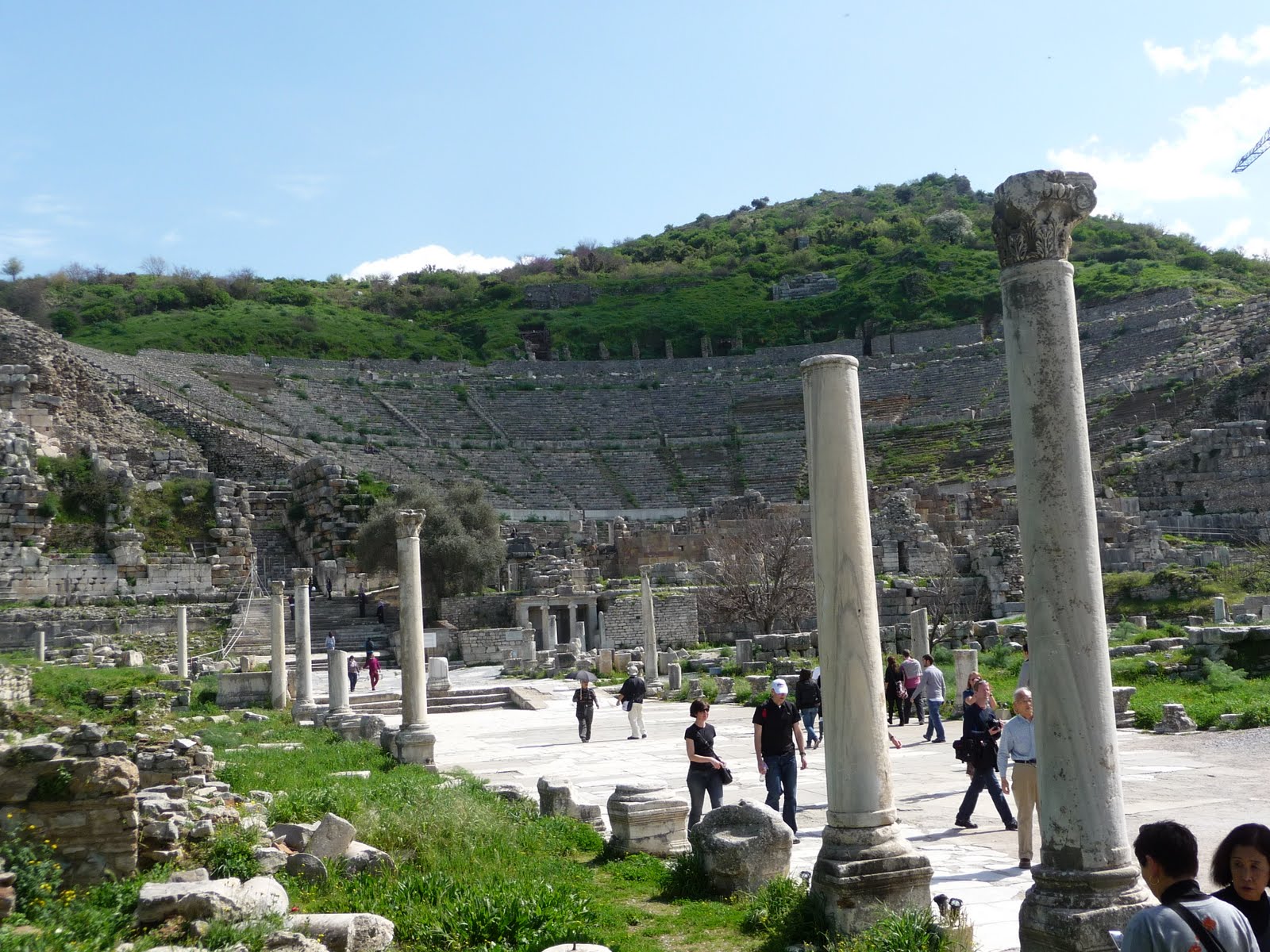
Ancient Empires and Conquerors: Reflections on my trip to Turkey, Greece and Italy
Under Alexander the Great, the Greeks conquered Turkey , Persia and most of the known world as far as India Byzantine Empire ruled the Mediterranean region for nearly 1000 years.
From about 1400 to 1800, the Ottoman Turks dominated the entire Mediterranean region, and controlled much of Egypt , Arabia and parts of Europe . They became the most powerful empire on earth. Although Emperor Charles V was the most powerful ruler in Europe , he trembled at the military might of the Turkish Sultan. Fortunately for Charles, the reigning Sultan died right when the Turkish armies were poised to take Vienna and to sweep further into Europe .
At any given time, Turkey , Greece , and Italy Istanbul Byzantine Empire ). Constantine left Italy Rome Constantinople . Later the city name changed to Byzantium and then finally to Istanbul
There are many visible remnants of these ancient empires. Museums overflow with statues, weapons, costumes, thrones, coins and sarcophagi commemorating ancient generals and kings. Ancient city ruins have been excavated and partly restored. Old stone roads that were built two thousand years ago still run through flourishing fields today. In Turkey
Spiritual Conquerors
An entirely different type of conqueror also profoundly affected these Mediterranean lands. Small bands of unarmed travelers walked along Roman roads with an entirely different vision of conquest. I am talking about the first Christians who arrived in the First Century. They sought to build an empire of the spirit. The evidence is hard to find at first glance. They left few objects to be found in museums nor did they build monuments. But in another sense, the evidence left by these spiritual conquerors is immense.
Saul of Tarsus was the most notable early Christian missionary. He started his life as a devout Jew and rose to high leadership in that community. When Christians started attracting many Jewish followers, Saul led the movement to exterminate them completely. But on a trip to Damascus
Paul walked on endless Roman roads with Barnabas, Silas, Mark, and Timothy to found new churches throughout Turkey Greece and Italy
Their teaching was deep love and compassion for all people: love for family, for neighbors, for strangers and for foreigners. Never before had such a compelling spiritual vision been offered with such great self sacrifice. These messengers were opposed, outlawed, tortured and killed in every city they visited. But still they marched on.
Leadership in early Christian communities was demonstrated by humility and by willingness to suffer. The Apostle Paul wrote a letter to the church in Rome
I consider that our present sufferings are not worth comparing with the glory that will be revealed in us... No, in all these things we are more than conquerors through him who loved us.
For I am convinced that neither death nor life, neither angels nor demons, neither the present nor the future, nor any powers, neither height nor depth, nor anything else in all creation, will be able to separate us from the love of God that is in Christ Jesus our Lord.
In today’s post-Christian world of Europe and North America , we forget how profoundly the Christian message changed history. It soon spread throughout Italy Italy
Eventually, all of the pagan tribes of Europe were converted to Christianity. Obviously, “converted” is a relative term, since no tribe or nation has ever become fully “Christian”. Even today I wince at things said and done supposedly in the name of Christ.
But the transformation of Europe was unmistakable. Read Sir Arnold Toynbee’s Study of History and his analysis of all civilizations that have been known since recorded history began. Though not a “Christian” himself, Sir Arnold credited Christianity with being the fundamental element of European Civilization. For centuries, this civilization was labeled “Christendom”. Later it became known as “Western Civilization”, and now its law, economics, and social vision have swept over the whole world.
Western Civilization brought us our calendar, our legal system, our modern concept of morality, social justice, public service, and the equality of all races and gender. It inspired universities, built hospitals, and freed slaves. Though many scholars in the 21st Century consider Christianity obsolete, they forget what the world was like before it arrived.
I am not a Fundamentalist. I have high regard for other religious traditions. I believe in fresh spiritual insights for every century. But to deny our debt to these First Century Christian pioneers is unthinkable. Mahatma Gandhi, Albert Einstein, and the best thinkers of our planet have recognized the potency for societal transformation that Jesus inspired.
Obviously, many bad things have been done by people allegedly following Jesus Christ. But these so-called followers with their personal agendas of coercion can never offset the world transformation brought about by his sublime teaching.
By contrast, memories of the great Mediterranean kings have been mostly lost in the sands of time. We still see lovely statues, crowns, jewelery, and crumbling monuments built in their honour. But they didn’t fundamentally change history. People hardly remembered which marauding army had come through last. Their glory was in rampage, blood-lust, and plunder.
The great English Romantic poet Percy Shelley wrote Ozymandias, which is about the futile poignancy of earthly conquest:
I met a traveler from an antique land
Who said: Two vast and trunkless legs of stone
Stand in the desert. Near them, on the sand,
Half sunk, a shattered visage lies, whose frown,
And wrinkled lip, and sneer of cold command,
Tell that its sculptor well those passions read
Which yet survive, stamped on these lifeless things,
The hand that mocked them, and the heart that fed;
And on the pedestal these words appear:
“My name is Ozymandias, king of kings:
Look upon my works, ye Mighty, and despair!”
Nothing beside remains. Round the decay
Of that colossal wreck, boundless and bare
The lone and level sands stretch far away.
Who said: Two vast and trunkless legs of stone
Stand in the desert. Near them, on the sand,
Half sunk, a shattered visage lies, whose frown,
And wrinkled lip, and sneer of cold command,
Tell that its sculptor well those passions read
Which yet survive, stamped on these lifeless things,
The hand that mocked them, and the heart that fed;
And on the pedestal these words appear:
“My name is Ozymandias, king of kings:
Look upon my works, ye Mighty, and despair!”
Nothing beside remains. Round the decay
Of that colossal wreck, boundless and bare
The lone and level sands stretch far away.
Far better then generals or kings were those spiritual pilgrims who conquered their own minds, and who learned not to lose their temper. They helped gradually transform a violent society into one that is more gentle. These spiritual conquerors achieved the true immortality that former kings and emperors only dreamed of. They brought us a taste of the
Monday, June 14, 2010


Monday, May 17, 2010
An Explainable Religious Faith
I have been traveling recently in Turkey, Greece and Italy. I heard many languages spoken. I saw evidence of religious faith in many places. I want to write a short explanation of my faith that could be understood by someone from a different culture and from another religious faith or perhaps no faith. So here are the main elements of what I believe:
I believe that it is very important to treat all people with the same love and respect that we show to our family and friends. We should treat neighbors and foreigners as we hope they will treat us.
That means forgiving others when they behave badly, loving difficult people, and having compassion for all people who are suffering. It means helping people in whatever way they urgently need to be helped.
It means treating everyone alike, whether they are male or female, young or old, rich or poor, educated or unschooled, of any religion or no religion. All people equally deserve my love and respect, no matter who they are.
Our natural tendency is to treat other people well only after they have demonstrated their good behaviour towards us. We tend to treat people well if they are already nice and friendly.
But that approach isn’t good enough to improve our world. Someone has to take the first initiative to offer goodwill whenever there is suspicion or hatred. To break the global curse of conflict and war, we must be willing to show love towards those who don’t (seem to) deserve it.
We need a higher moral and ethical standard than education, government or logic can produce in us. I believe that higher standard can only come through God’s inspiration.
Most people throughout the centuries have believed in God or in a Higher Power of some form. Regrettably, our human tendency is mostly to reject God’s wisdom. We would rather do everything our own way, even if it is wrong. Our unwillingness to listen God’s suggestions is the main cause of conflict and suffering.
There are many forms of religion in this world, but not all of them work equally well. I spent more than a decade investigating various religions, including Hinduism, Buddhism, Islam and Atheism. I have concluded that Jesus is the best guide to life. I have found no other faith teaching as helpful as his.
Jesus showed us how to find God’s wisdom and to follow it carefully. Unfortunately, many followers of Jesus do not imitate his life style. But whenever we practice his way of listening to God and loving everyone, we find new reason for hope. Jesus created a better world all around him by following God constantly. If we learn to listen intently to God, we will be inspired build a far better world around us.
Through Jesus, we see the face of God. It was for this reason that God sent Jesus to us. Jesus was willing to bet his life on his relationship with his Father God. Jesus died and returned to life to show us the potential for immortal life. That is our deepest longing: to live forever in a better place, on a higher plane.
I believe in miraculous events, but not in humans having magical powers. I see God doing astonishing things in my neighbourhood that you and I could never accomplish without Divine help.
I sense the Spirit of God participating in my daily life. In quiet moments I receive Spirit guidance for my challenges and my projects.
My faith affects everything I do and say. It changes who I am.
Not that I always get things right. I make many mistakes despite my belief in a higher standard. Often I don’t treat others with enough love and respect. But that doesn’t negate my faith.
I am on a long journey of learning: how to live and die, and how to find eternal life. My goal is to help bring a little bit of heaven down to earth. That is the Kingdom of God, the Kingdom of Heaven which Jesus demonstrated for us.
I believe that it is very important to treat all people with the same love and respect that we show to our family and friends. We should treat neighbors and foreigners as we hope they will treat us.
That means forgiving others when they behave badly, loving difficult people, and having compassion for all people who are suffering. It means helping people in whatever way they urgently need to be helped.
It means treating everyone alike, whether they are male or female, young or old, rich or poor, educated or unschooled, of any religion or no religion. All people equally deserve my love and respect, no matter who they are.
Our natural tendency is to treat other people well only after they have demonstrated their good behaviour towards us. We tend to treat people well if they are already nice and friendly.
But that approach isn’t good enough to improve our world. Someone has to take the first initiative to offer goodwill whenever there is suspicion or hatred. To break the global curse of conflict and war, we must be willing to show love towards those who don’t (seem to) deserve it.
We need a higher moral and ethical standard than education, government or logic can produce in us. I believe that higher standard can only come through God’s inspiration.
Most people throughout the centuries have believed in God or in a Higher Power of some form. Regrettably, our human tendency is mostly to reject God’s wisdom. We would rather do everything our own way, even if it is wrong. Our unwillingness to listen God’s suggestions is the main cause of conflict and suffering.
There are many forms of religion in this world, but not all of them work equally well. I spent more than a decade investigating various religions, including Hinduism, Buddhism, Islam and Atheism. I have concluded that Jesus is the best guide to life. I have found no other faith teaching as helpful as his.
Jesus showed us how to find God’s wisdom and to follow it carefully. Unfortunately, many followers of Jesus do not imitate his life style. But whenever we practice his way of listening to God and loving everyone, we find new reason for hope. Jesus created a better world all around him by following God constantly. If we learn to listen intently to God, we will be inspired build a far better world around us.
Through Jesus, we see the face of God. It was for this reason that God sent Jesus to us. Jesus was willing to bet his life on his relationship with his Father God. Jesus died and returned to life to show us the potential for immortal life. That is our deepest longing: to live forever in a better place, on a higher plane.
I believe in miraculous events, but not in humans having magical powers. I see God doing astonishing things in my neighbourhood that you and I could never accomplish without Divine help.
I sense the Spirit of God participating in my daily life. In quiet moments I receive Spirit guidance for my challenges and my projects.
My faith affects everything I do and say. It changes who I am.
Not that I always get things right. I make many mistakes despite my belief in a higher standard. Often I don’t treat others with enough love and respect. But that doesn’t negate my faith.
I am on a long journey of learning: how to live and die, and how to find eternal life. My goal is to help bring a little bit of heaven down to earth. That is the Kingdom of God, the Kingdom of Heaven which Jesus demonstrated for us.
Saturday, February 27, 2010
Searching for a Credible Faith?
From time to time I meet people who are searching for a dependable faith. The older woman I mentioned in my April 23, 2009 blog post “I Believe in the Absence of God” was one of them.
I met this same woman again recently at my swimming pool and she questioned me intensely about my faith. This surprised me since she hardly knows me. She is searching eagerly for a source of hope before she dies—but she is not prepared to settle for any belief that lacks credibility. The blind faith she had as a child disappointed her. She now wants to find TRUTH, not just pleasant myth. Finding a reliable faith has been my life-quest as well.
I use the term “faith” (or religion) to mean our ultimate road-map for life. This concept applies to an individual, and also to a family or a community of people. It helps to have a group of people living together who share the same values and the same “faith” road-map. That is a faith community.
So in a sense, a Materialist or an Atheist can also have a “faith”—faith is defined as whatever system of living and thinking that we are willing to bet our life on.
Both Albert Einstein and the renowned British historian Arnold Toynbee included Communism and other secular belief systems in their observation of religious phenomena. I quite agree with them: any system of thought and practice that drives its adherents with consuming passion is a kind of “religion” or “faith”.
I would include “Environmentalism”; in my category of faith. Some of my friends believe that there is nothing more worth living and dying for than to save the fragile planetary environment. Heroes of Greenpeace have risked their lives in trying to save the planet and its endangered species. Although their faith is not supreme wisdom for living, I have no quarrel with most of their goals. On the other hand, they may fail to address some of life’s most perplexing questions. Or they may worship Creation, but forget its CREATOR.
The term faith implies principles we believe intensely, but that cannot be proven to a skeptic. True faith involves struggle and contention, almost by definition.
Faith is also something we value so much that we naturally want to share it with friends. That may cause conflict, particularly if we become too zealous and impatient to convince others.
Any search for faith that is not linked to finding wisdom and understanding will eventually prove unsatisfying. Real faith changes our emotions, but it should persuade our minds as well.
The religion of my childhood seemed too peculiar for me to accept without question. People in my Amish Mennonite community in the 1950’s followed their traditions as best they could. However, they believed some things that seemed naive, if not foolish to me.
My father was an example of this naivete, although he was also a marvelous man in many respects. My Dad was born over a hundred years ago in 1906. He dropped out of school after grade six to help support his family when his mother died in the great flue epidemic of 1918. Like many rural people, Dad had some far-fetched ideas that seemed laughable to his better educated children.
For instance, my father claimed that fishing worms fell down from the sky whenever it rained. There is no doubt that whenever there was a heavy rain at our farm, the ground was covered with earthworms; they came out of the earth to avoid drowning. My father’s interpretation, however, was that the worms fell down out of the sky together with the rain. His observations fit the facts as he understood them, but his line of reasoning was humorously deficient. His approach to the Bible seemed equally haphazard to me.
Traditional religions often become mixed up with elements of superstition or folk tales. We see this ofttimes in other people’s religions, but not always in our own tradition. I notice that city dwellers have their own superstitions, such as astrology. Whenever there is an absence of real faith, then folk tales and superstitions fill the vacuum.
Albert Einstein famously remarked: “All men are equally wise and equally foolish before God”. The Infinite One must laugh at the pretentions of small earth dwellers. How little we humans truly understand; but our preachers and academic teachers hold forth with bland confidence nonetheless on subjects none of us understand very clearly.
After years of observing religion and faith in its many forms, I have become less critical of primitive and traditional religion. I did not realize as a boy that people admired my Amish Mennonite family. I thought we were far too peculiar to be accepted by our neighbors. However, most people have considerable respect for sincere believers: whether they are Catholics, Baptists, Jews, Buddhists, or Environmentalists. In one sense, each of these faiths is incredible. Perhaps that is the very nature of faith—to believe profoundly in what other people do not (yet) find convincing.
I have concluded that even the ignorant and simple people rarely go far wrong when they sincerely try to follow their scriptures—that is exactly what scriptures are for. Thus in my older years, I find that I believe many if not most of the things that my father held dear. I don’t accept all of his superstitions, but I find faith in God, in Jesus, and in the Bible better for me than any of the alternative faiths/religions that I have investigated.
Although some people may be struck by the lightning of God’s truth at any age, authentic faith must be proven genuine on the battlefield of life. Faith that is not pure gold will not endure the refiner’s fire.
It is God who fortunately reveals Himself to those who seek Him; it does not depend on our intellectual sophistication. That is why highly educated people may never find faith, while simple folks are still finding God all around the world. Humility before the ULTIMATE INTELLIGENCE is the only requirement for faith and worship.
The language of faith is mysterious because it attempts to describe a REALITY so much larger than human intelligence can grasp or explain. Faith may sometimes seem vague or precarious, but it is a lifeline. It brings hope, enthusiasm, courage and vision. It depends more on guidance from above, than our mental gymnastics.
Where faith is totally lacking, people find life very dark. However, there is always light available for those who will follow it. That light grows gradually brighter as we approach the ONE who lives in LIGHT. St. Paul describes God to his young friend Timothy as the one … “Who alone is immortal and who lives in unapproachable light, whom no one has seen or can see. To him be honour and might forever.”
Faith should be credible, but it will also remain tantalizingly and spectacularly incredible.
I met this same woman again recently at my swimming pool and she questioned me intensely about my faith. This surprised me since she hardly knows me. She is searching eagerly for a source of hope before she dies—but she is not prepared to settle for any belief that lacks credibility. The blind faith she had as a child disappointed her. She now wants to find TRUTH, not just pleasant myth. Finding a reliable faith has been my life-quest as well.
I use the term “faith” (or religion) to mean our ultimate road-map for life. This concept applies to an individual, and also to a family or a community of people. It helps to have a group of people living together who share the same values and the same “faith” road-map. That is a faith community.
So in a sense, a Materialist or an Atheist can also have a “faith”—faith is defined as whatever system of living and thinking that we are willing to bet our life on.
Both Albert Einstein and the renowned British historian Arnold Toynbee included Communism and other secular belief systems in their observation of religious phenomena. I quite agree with them: any system of thought and practice that drives its adherents with consuming passion is a kind of “religion” or “faith”.
I would include “Environmentalism”; in my category of faith. Some of my friends believe that there is nothing more worth living and dying for than to save the fragile planetary environment. Heroes of Greenpeace have risked their lives in trying to save the planet and its endangered species. Although their faith is not supreme wisdom for living, I have no quarrel with most of their goals. On the other hand, they may fail to address some of life’s most perplexing questions. Or they may worship Creation, but forget its CREATOR.
The term faith implies principles we believe intensely, but that cannot be proven to a skeptic. True faith involves struggle and contention, almost by definition.
Faith is also something we value so much that we naturally want to share it with friends. That may cause conflict, particularly if we become too zealous and impatient to convince others.
Any search for faith that is not linked to finding wisdom and understanding will eventually prove unsatisfying. Real faith changes our emotions, but it should persuade our minds as well.
The religion of my childhood seemed too peculiar for me to accept without question. People in my Amish Mennonite community in the 1950’s followed their traditions as best they could. However, they believed some things that seemed naive, if not foolish to me.
My father was an example of this naivete, although he was also a marvelous man in many respects. My Dad was born over a hundred years ago in 1906. He dropped out of school after grade six to help support his family when his mother died in the great flue epidemic of 1918. Like many rural people, Dad had some far-fetched ideas that seemed laughable to his better educated children.
For instance, my father claimed that fishing worms fell down from the sky whenever it rained. There is no doubt that whenever there was a heavy rain at our farm, the ground was covered with earthworms; they came out of the earth to avoid drowning. My father’s interpretation, however, was that the worms fell down out of the sky together with the rain. His observations fit the facts as he understood them, but his line of reasoning was humorously deficient. His approach to the Bible seemed equally haphazard to me.
Traditional religions often become mixed up with elements of superstition or folk tales. We see this ofttimes in other people’s religions, but not always in our own tradition. I notice that city dwellers have their own superstitions, such as astrology. Whenever there is an absence of real faith, then folk tales and superstitions fill the vacuum.
Albert Einstein famously remarked: “All men are equally wise and equally foolish before God”. The Infinite One must laugh at the pretentions of small earth dwellers. How little we humans truly understand; but our preachers and academic teachers hold forth with bland confidence nonetheless on subjects none of us understand very clearly.
After years of observing religion and faith in its many forms, I have become less critical of primitive and traditional religion. I did not realize as a boy that people admired my Amish Mennonite family. I thought we were far too peculiar to be accepted by our neighbors. However, most people have considerable respect for sincere believers: whether they are Catholics, Baptists, Jews, Buddhists, or Environmentalists. In one sense, each of these faiths is incredible. Perhaps that is the very nature of faith—to believe profoundly in what other people do not (yet) find convincing.
I have concluded that even the ignorant and simple people rarely go far wrong when they sincerely try to follow their scriptures—that is exactly what scriptures are for. Thus in my older years, I find that I believe many if not most of the things that my father held dear. I don’t accept all of his superstitions, but I find faith in God, in Jesus, and in the Bible better for me than any of the alternative faiths/religions that I have investigated.
Although some people may be struck by the lightning of God’s truth at any age, authentic faith must be proven genuine on the battlefield of life. Faith that is not pure gold will not endure the refiner’s fire.
It is God who fortunately reveals Himself to those who seek Him; it does not depend on our intellectual sophistication. That is why highly educated people may never find faith, while simple folks are still finding God all around the world. Humility before the ULTIMATE INTELLIGENCE is the only requirement for faith and worship.
The language of faith is mysterious because it attempts to describe a REALITY so much larger than human intelligence can grasp or explain. Faith may sometimes seem vague or precarious, but it is a lifeline. It brings hope, enthusiasm, courage and vision. It depends more on guidance from above, than our mental gymnastics.
Where faith is totally lacking, people find life very dark. However, there is always light available for those who will follow it. That light grows gradually brighter as we approach the ONE who lives in LIGHT. St. Paul describes God to his young friend Timothy as the one … “Who alone is immortal and who lives in unapproachable light, whom no one has seen or can see. To him be honour and might forever.”
Faith should be credible, but it will also remain tantalizingly and spectacularly incredible.
Thursday, January 07, 2010
Trying to Comprehend a “Billion Times Bigger” God
We live in the Star Trek generation. Images of space travel are commonplace in movies and on TV. But most of us are oblivious to how drastically our world view has shifted during the past century.
I grew in up the 1940’s and 1950’s with uneducated farmers and tradesmen who retained much of the perspective of earlier centuries. One of my mother’s cousins questioned the idea that the Earth rotates around the Sun, because Old Testament scriptures in the King James Translation seemed to imply that earth is fixed at the center of the Universe.
Although I heard about the Russian Sputnik, the first satellite ever launched in 1957, my awareness of the stars and galaxies was minimal until I went to Harvard College.
I took a course in Astronomy in 1965. My Professor was Dr. Owen Gingerich. Little did I realize how profoundly this course would change my understanding of the universe. Nor did I realize that Professor Gingerich would become one of the better known and respected astronomers in the world.
Professor Gingerich explained the historical development of Astronomy and taught us the mathematical formulas that are used to calculate the size of the earth and to measure distances to the moon and to the other planets in our solar system.
We studied the great 16th Century astronomer Nicolaus Copernicus whose mathematical calculations of planetary orbits demonstrated why the earth could not be the center of the universe as was commonly believed in his era. Johannes Kepler and Galileo Galilei extended this research which brought a stinging rebuke from the Pope.
But it was not until the 19th and 20th centuries that astronomers discovered the full extent of the universe. This required new telescopes and other scientific instruments for observation. The distances of inter stellar space were so vast that entirely new concepts of measurement were needed.
The concept of light years still astounds me. If we could board a space ship and travel at the speed of light (roughly 186,300 miles per second) it would take us more than four years to travel to the nearest star, Proxima Centauri. However, traveling at the speed of our most distant space probe, Voyager 1, this journey would require 72,000 years just to reach this nearest star.
Our Galaxy, the Milky Way, has an estimated 200 - 400 billion stars that are the size of our sun or up to 100 times larger. The Milky Way stretches about 100,000 light years across. Our neighboring galaxy, the Andromeda, contains about a trillion stars. The universe is estimated to contain 80 billion (or more) galaxies like the Milky Way. The total number of stars is estimated to be more than 50 billion trillion (50 sextillion stars).
I sympathize with the 16th and 17th Century Vatican officials who rejected the revolutionary concept of a universe without the Earth at its center. And I understand the profound religious disturbance which is still being caused by a virtually infinite universe.
This radical development is upsetting the religious views developed over the past 3,000 years. Just when humans believed that we had figured out our World, our God and the Universe, new astronomic information has upset our view of the Cosmos.
The God which humanity had previously conceived of seemed powerful and ancient, but ruling only a single planet, plus some heavenly lights in the sky. (The lesser Greek gods were scarcely beyond the realm of mortals.)
But now we must either dispense with the God concept altogether, or else try to comprehend a Being that is billions or trillions of times larger. This development is profoundly challenging our religious and spiritual concepts. There have been at least four different responses:
1. This new information about the vast scale of universe has caused many people to abandon religion and faith altogether, particularly in the academic and scientific community. The world of faith and spirituality involves a different way of perceiving from the rational calculations of science. Some call this left brain and right brain. While some scientists have no problem using both kinds of thinking, others demand a single rational mode to make ultimate determinations. They want God to be proved by scientific methods, or else abolished completely.
2. Other people have retained religious concepts and practices as useful myths for our rites of passage, but for little more. They have become practical atheists with a nostalgic religious culture.
3. At the other extreme there are religious people who ignore or deny this new scientific information in order to hold on tightly to their historic faith. They view science with extreme skepticism. They see science as the enemy of faith.
4. Finally, some people refuse to discard either the new information coming from scientific observation, or to dispense with findings from the spiritual world. They hold both in dynamic tension. Albert Einstein was in this group and so is my former Professor Owen Gingerich.
He sees the hand of a creator at work in every aspect of nature, from interstellar space to the smallest aspects of the human gene. Dr. Gingerich remarked:
“As we look into the next millennium, we can see some redemption from suffering and evil in the hands of scientists. They can stem the scourge of plagues, can help bring forth more abundant produce from the earth, can tap the abundant energy of sunshine. Yet some of those same keys also unlock biological warfare, can generate monsters, can destroy our atmosphere.
“Salvation does not come from science. Salvation comes from age-old insights into human nature, and the on-going quest to be reconciled to God. It comes from Jesus not only reminding us to love our neighbors as ourselves, but with the parable of the Good Samaritan, where he told us our neighbors can be strangers anywhere.”
So what kind of God can we try to imagine? God is not a billion times bigger than before, because God doesn’t change. God was just as big when he called Abraham out of Ur and when Jesus was born in Bethlehem.
I believe that God is the Source of all music, all inspiration, all knowledge, all design, all thought, all power, and the source of all matter and energy. He inhabits the affairs of the entire universe from immensely large to infinitesimally small. Even the most brilliant human minds today can grasp only a tiny fragment of all that God has created.
The most astonishing thing of all is that this immensely powerful God still communicates with us and nourishes us in more ways than we ever comprehend.
I grew in up the 1940’s and 1950’s with uneducated farmers and tradesmen who retained much of the perspective of earlier centuries. One of my mother’s cousins questioned the idea that the Earth rotates around the Sun, because Old Testament scriptures in the King James Translation seemed to imply that earth is fixed at the center of the Universe.
Although I heard about the Russian Sputnik, the first satellite ever launched in 1957, my awareness of the stars and galaxies was minimal until I went to Harvard College.
I took a course in Astronomy in 1965. My Professor was Dr. Owen Gingerich. Little did I realize how profoundly this course would change my understanding of the universe. Nor did I realize that Professor Gingerich would become one of the better known and respected astronomers in the world.
Professor Gingerich explained the historical development of Astronomy and taught us the mathematical formulas that are used to calculate the size of the earth and to measure distances to the moon and to the other planets in our solar system.
We studied the great 16th Century astronomer Nicolaus Copernicus whose mathematical calculations of planetary orbits demonstrated why the earth could not be the center of the universe as was commonly believed in his era. Johannes Kepler and Galileo Galilei extended this research which brought a stinging rebuke from the Pope.
But it was not until the 19th and 20th centuries that astronomers discovered the full extent of the universe. This required new telescopes and other scientific instruments for observation. The distances of inter stellar space were so vast that entirely new concepts of measurement were needed.
The concept of light years still astounds me. If we could board a space ship and travel at the speed of light (roughly 186,300 miles per second) it would take us more than four years to travel to the nearest star, Proxima Centauri. However, traveling at the speed of our most distant space probe, Voyager 1, this journey would require 72,000 years just to reach this nearest star.
Our Galaxy, the Milky Way, has an estimated 200 - 400 billion stars that are the size of our sun or up to 100 times larger. The Milky Way stretches about 100,000 light years across. Our neighboring galaxy, the Andromeda, contains about a trillion stars. The universe is estimated to contain 80 billion (or more) galaxies like the Milky Way. The total number of stars is estimated to be more than 50 billion trillion (50 sextillion stars).
I sympathize with the 16th and 17th Century Vatican officials who rejected the revolutionary concept of a universe without the Earth at its center. And I understand the profound religious disturbance which is still being caused by a virtually infinite universe.
This radical development is upsetting the religious views developed over the past 3,000 years. Just when humans believed that we had figured out our World, our God and the Universe, new astronomic information has upset our view of the Cosmos.
The God which humanity had previously conceived of seemed powerful and ancient, but ruling only a single planet, plus some heavenly lights in the sky. (The lesser Greek gods were scarcely beyond the realm of mortals.)
But now we must either dispense with the God concept altogether, or else try to comprehend a Being that is billions or trillions of times larger. This development is profoundly challenging our religious and spiritual concepts. There have been at least four different responses:
1. This new information about the vast scale of universe has caused many people to abandon religion and faith altogether, particularly in the academic and scientific community. The world of faith and spirituality involves a different way of perceiving from the rational calculations of science. Some call this left brain and right brain. While some scientists have no problem using both kinds of thinking, others demand a single rational mode to make ultimate determinations. They want God to be proved by scientific methods, or else abolished completely.
2. Other people have retained religious concepts and practices as useful myths for our rites of passage, but for little more. They have become practical atheists with a nostalgic religious culture.
3. At the other extreme there are religious people who ignore or deny this new scientific information in order to hold on tightly to their historic faith. They view science with extreme skepticism. They see science as the enemy of faith.
4. Finally, some people refuse to discard either the new information coming from scientific observation, or to dispense with findings from the spiritual world. They hold both in dynamic tension. Albert Einstein was in this group and so is my former Professor Owen Gingerich.
He sees the hand of a creator at work in every aspect of nature, from interstellar space to the smallest aspects of the human gene. Dr. Gingerich remarked:
“As we look into the next millennium, we can see some redemption from suffering and evil in the hands of scientists. They can stem the scourge of plagues, can help bring forth more abundant produce from the earth, can tap the abundant energy of sunshine. Yet some of those same keys also unlock biological warfare, can generate monsters, can destroy our atmosphere.
“Salvation does not come from science. Salvation comes from age-old insights into human nature, and the on-going quest to be reconciled to God. It comes from Jesus not only reminding us to love our neighbors as ourselves, but with the parable of the Good Samaritan, where he told us our neighbors can be strangers anywhere.”
So what kind of God can we try to imagine? God is not a billion times bigger than before, because God doesn’t change. God was just as big when he called Abraham out of Ur and when Jesus was born in Bethlehem.
I believe that God is the Source of all music, all inspiration, all knowledge, all design, all thought, all power, and the source of all matter and energy. He inhabits the affairs of the entire universe from immensely large to infinitesimally small. Even the most brilliant human minds today can grasp only a tiny fragment of all that God has created.
The most astonishing thing of all is that this immensely powerful God still communicates with us and nourishes us in more ways than we ever comprehend.
Wednesday, December 02, 2009
Materialism and Scientism: A Religion of Despair?
When I was a young student at Harvard, I embraced the religion of the avant-garde: a rejection of God and the adulation of human accomplishments, particularly of science. Friedrich Nietzsche had declared a century earlier that “God is dead”, but it wasn’t until the 20th Century that so many educated people flocked to this new philosophy.
Some call this Atheism. Others call it Materialism, since its believers deny any reality beyond the material. But I like the term “Scientism” since it most accurately describes the new religion: the dogmatic worship of Science.
My university days were the most lonely and despairing time of my life, but I didn’t realize the cause of my malaise. Fortunately, in time I saw the limits of non-faith and started a search for something positive to believe. To my surprise, I gradually rediscovered the sublime beauty of Christian faith after trying several alternatives.
I believe that the most serious challenge to traditional faith is not the contending denominations within Christianity. Nor is it even the differences we have with other faiths. Rather, it is the complete negation of soul, of spirit, and of any Higher Intelligence.
Let me quote from one of the early advocates of Scientism, Bertrand Russell:
“That man is the product of causes which had no provision of the end they were achieving;
that his origin, his growth, his hopes and fears, his loves and his beliefs, are but the outcome of accidental collocations of atoms;
that no fire, no heroism, no intensity of thought or feeling, can preserve an individual life beyond the grave;
that all of the labours of the ages, all the devotion, all the inspiration, all the noonday brightness of human genius, are destined to extinction in the vast death of the solar system;
and the whole temple of Man’s achievement must inevitably be buried beneath the debris of a universe in ruins—all these things, if not quite beyond dispute, are yet so nearly certain, that no philosophy that rejects them can hope to stand.
Only within the scaffolding of these new truths, only on the firm foundation of unyielding despair, can the soul’s habitation henceforth be safely built.”
I am indebted to Charles Tart who in his recent book The End of Materialism described this new belief system so clearly. My religious views are different from Charles, but I appreciate his observations on spirituality and how it can be reconciled with science.
I have high respect for science and for scientists. But like Einstein, I see science as the handiwork of a great Higher Intelligence, who created the endless galaxies, as well as the subatomic realm.
The central pillar of my belief is this great God who has communicated with humans throughout all ages. I am not distressed by the seeming disparity of religious beliefs. When you consider how minuscule is our intelligence compared to that vast INTELLIGENCE of our Creator, how could any of us ever begin to comprehend or to explain His marvellous nature fully? How could we begin to explain Heaven, His Celestial Dwelling beyond matter and time?
Fortunately, we have no need to fully understand these wondrous matters. We need only enough wisdom to live our lives. And we need charity, sympathy and tolerance for those who see things differently from us. We can never persuade anyone by arguing, although civilized conversation is helpful.
Regrettably, our public schools and universities have outlawed all expressions of faith except for the beliefs of Scientism. That is a tragedy. However, people of faith have partly brought this upon ourselves through our own religious dogmatism. We deify our own moral understanding which we mistake for God’s law. We reject scientific observations if they seem to conflict with our beliefs, rather than pondering them carefully.
For instance, I believe we have lost credibility by our total opposition to evolutionary theory. Most scientists speculate that the universe began in one instant in time by a cosmic explosion—the “Big Bang” theory. So why not hold on to the more defensible belief that only God could have brought about such an amazing creation of the universe in one second? Whether God created Man in one day or He is still continuing to create life matters little, so long as He is the Creator. The details of earliest human history are lost in fog. Why not acknowledge that the ways of God are so far beyond us, that we don’t always know his methods. Evolutionary theory could well be wrong in various respects, but likely so are some of our own concepts about God and how he works.
I believe in the essentials of the Christian faith of my ancestors. Not because they were so wise—like us, they could only see “as through a glass darkly”. But God has provided enough light and inspiration to humanity in every culture and in each century so that we could know Him. The changes of belief over time and across cultures are not fundamental. I believe God is leading us gently to a better understanding.
The problem with Scientism is that with God dead, and the universe governed by random chance, humanity has no protection and no assurance for the future. Furthermore, there is no answer to death, despite frantic research to extend our lives. It is not surprising that this belief system brings loneliness and despair.
Humanity stands at a crossroad. Those who share a traditional faith in God must learn to get along, despite our many differences. We also need to engage lovingly and thoughtfully with those who have lost faith in anything greater than science. That view brings the despair evident in Russell’s comments. Our faith brings a strong hope:
So long as God is in His Heaven, all will be right with the world!
Some call this Atheism. Others call it Materialism, since its believers deny any reality beyond the material. But I like the term “Scientism” since it most accurately describes the new religion: the dogmatic worship of Science.
My university days were the most lonely and despairing time of my life, but I didn’t realize the cause of my malaise. Fortunately, in time I saw the limits of non-faith and started a search for something positive to believe. To my surprise, I gradually rediscovered the sublime beauty of Christian faith after trying several alternatives.
I believe that the most serious challenge to traditional faith is not the contending denominations within Christianity. Nor is it even the differences we have with other faiths. Rather, it is the complete negation of soul, of spirit, and of any Higher Intelligence.
Let me quote from one of the early advocates of Scientism, Bertrand Russell:
“That man is the product of causes which had no provision of the end they were achieving;
that his origin, his growth, his hopes and fears, his loves and his beliefs, are but the outcome of accidental collocations of atoms;
that no fire, no heroism, no intensity of thought or feeling, can preserve an individual life beyond the grave;
that all of the labours of the ages, all the devotion, all the inspiration, all the noonday brightness of human genius, are destined to extinction in the vast death of the solar system;
and the whole temple of Man’s achievement must inevitably be buried beneath the debris of a universe in ruins—all these things, if not quite beyond dispute, are yet so nearly certain, that no philosophy that rejects them can hope to stand.
Only within the scaffolding of these new truths, only on the firm foundation of unyielding despair, can the soul’s habitation henceforth be safely built.”
I am indebted to Charles Tart who in his recent book The End of Materialism described this new belief system so clearly. My religious views are different from Charles, but I appreciate his observations on spirituality and how it can be reconciled with science.
I have high respect for science and for scientists. But like Einstein, I see science as the handiwork of a great Higher Intelligence, who created the endless galaxies, as well as the subatomic realm.
The central pillar of my belief is this great God who has communicated with humans throughout all ages. I am not distressed by the seeming disparity of religious beliefs. When you consider how minuscule is our intelligence compared to that vast INTELLIGENCE of our Creator, how could any of us ever begin to comprehend or to explain His marvellous nature fully? How could we begin to explain Heaven, His Celestial Dwelling beyond matter and time?
Fortunately, we have no need to fully understand these wondrous matters. We need only enough wisdom to live our lives. And we need charity, sympathy and tolerance for those who see things differently from us. We can never persuade anyone by arguing, although civilized conversation is helpful.
Regrettably, our public schools and universities have outlawed all expressions of faith except for the beliefs of Scientism. That is a tragedy. However, people of faith have partly brought this upon ourselves through our own religious dogmatism. We deify our own moral understanding which we mistake for God’s law. We reject scientific observations if they seem to conflict with our beliefs, rather than pondering them carefully.
For instance, I believe we have lost credibility by our total opposition to evolutionary theory. Most scientists speculate that the universe began in one instant in time by a cosmic explosion—the “Big Bang” theory. So why not hold on to the more defensible belief that only God could have brought about such an amazing creation of the universe in one second? Whether God created Man in one day or He is still continuing to create life matters little, so long as He is the Creator. The details of earliest human history are lost in fog. Why not acknowledge that the ways of God are so far beyond us, that we don’t always know his methods. Evolutionary theory could well be wrong in various respects, but likely so are some of our own concepts about God and how he works.
I believe in the essentials of the Christian faith of my ancestors. Not because they were so wise—like us, they could only see “as through a glass darkly”. But God has provided enough light and inspiration to humanity in every culture and in each century so that we could know Him. The changes of belief over time and across cultures are not fundamental. I believe God is leading us gently to a better understanding.
The problem with Scientism is that with God dead, and the universe governed by random chance, humanity has no protection and no assurance for the future. Furthermore, there is no answer to death, despite frantic research to extend our lives. It is not surprising that this belief system brings loneliness and despair.
Humanity stands at a crossroad. Those who share a traditional faith in God must learn to get along, despite our many differences. We also need to engage lovingly and thoughtfully with those who have lost faith in anything greater than science. That view brings the despair evident in Russell’s comments. Our faith brings a strong hope:
So long as God is in His Heaven, all will be right with the world!
Thursday, October 22, 2009
Three contemporary versions of Psalm 23
1. The Message translation by Eugene Peterson
1-3 God, my shepherd! I don't need a thing.
You have bedded me down in lush meadows,
you find me quiet pools to drink from.
True to your word,
you let me catch my breath
and send me in the right direction.
4 Even when the way goes through
I'm not afraid
when you walk at my side.
Your trusty shepherd's crook
makes me feel secure.
5 You serve me a six-course dinner
right in front of my enemies.
You revive my drooping head;
my cup brims with blessing.
6 Your beauty and love chase after me
every day of my life.
I'm back home in the house of God
for the rest of my life.
2. Psalm 23 Antithesis (author: anonymous)
The clock is my dictator, I shall not rest.
It makes me lie down only when exhausted.
It leads me into deep depression.
It hounds my soul.
It leads me in circles of frenzy, for activities sake.
Even though I run frantically from task to task,
I will never get it all done,
For my ideal is with me
Deadlines and my need for approval, they drive me.
They demand performance from me, beyond the limits of my schedule.
They anoint my head with migraines
My in-basket overflows.
Surely fatigue and time pressures shall follow me
All the days of my life.
And I will dwell in the bonds of frustration forever.
3. Psalm 23, Japanese version:
The Lord is my pace setter, I shall not rush.
He makes me stop and rest for quiet intervals.
He provides me with images of stillness which restore my serenity.
He leads me in ways of efficiency through calmness of mind, and his guidance is peace.
Even though I have a great many things to accomplish each day, I will not fret, for his presence is here.
His timelessness, His all-importance will keep me in balance.
He prepares refreshment and renewal in the midst of my activity, by anointing my mind with his oils of tranquility.
My cup of joyous energy overflows; surely harmony and effectiveness shall be the fruits of my hours.
For I shall walk in the pace of my Lord, and dwell in His house forever.
Tuesday, August 04, 2009
Dealing with Life’s Disappointments
I just returned from a somewhat disappointing trip to the
When I had almost recovered, my wife and other relatives caught an even worse flu with constant diarrhea. This disrupted our vacation plans of canoeing, sightseeing, swimming. Furthermore, the weather in the Midwest was cold and rainy most of the time, which dampened our summer fun. In
I could write pages more about disappointments, both yours and mine. Close friends have a teenage son with severe recurring cancer. Another friend has a homeless brother who has fallen into a nameless coma. People all around are losing jobs. Highly talented young people can’t find work commensurate with their abilities. Seniors have lost a lot of their retirement funds in the financial crisis.
A natural response to our disappointments is resentment. We can vent our rage. We can sulk and withdraw from life’s seeming caprice.
But that is not our only option. We can also acknowledge our disappointments but still make the best of our life situation.
One of the great inspirations of my life was watching the heroic death of Linda Bergwall, who had worked in
When Jim and Linda visited our church, they taught us this poignant litany:
God is Good
All of the Time.
All of the Time
God is Good!
To watch Linda’s joyful faith when she was being consumed by cancer seemed contradictory, almost naïve. Yet, I believe she and Jim got it exactly right. It is hard to explain how God is good when our world is in such a hopeless mess. But that is the essence of faith.
I have found several ways to minimize disappointments so that they don’t derail our lives. The first is to Reduce Expectations. Fortunately, I had remembered how many things can go wrong on a family vacation, so I was not surprised by this summer’s events. However, at other times things succeed beyond our imagination. My maxim is high hopes, but low expectations. Giving up on our hopes is not good, but having high expectations that are so often dashed is also frustrating. Essentially, we need to remember that life has lots of ups and downs. We should prepare for both good times and hard times. Neither lasts indefinitely.
A second way to limit the damage is Calm Acceptance. We can not avoid most of the difficulties we encounter, but we have some power over our reactions. Sometimes we dwell on our misfortunes, we complain loudly and look around for who is to blame. A better way is to let the harsh wind blow over us then pick ourselves up and move forward. Otherwise we waste precious energy bewailing our fate.
A third method to avoid being depressed by misfortunes is to Live in the present. Anticipating a wonderful vacation for many weeks seems OK, but can prove disastrous when it fails to materialize. I know a couple that invested huge energy and money for a year abroad; this actually wrecked their marriage when the reality of the experience turned out so much worse than the imagined pleasures. Equally, fretting about past disasters is a barrier to moving ahead. Each day has fresh opportunities and pitfalls. But we need to live one day at a time.
My last suggestion is Embracing Life to the fullest. At my age health concerns for my generation can become all consuming. Talk about diseases, medicines, vitamins, miracle cures, rejuvenation can fill days of conversation. In my experience, these are not only of little value, but they distract from the wonders all around us.
If we calmly accept that our lives will end, sooner or later, we are freed to embrace the delights of life. I have never so appreciated hearing bird calls before, nor savoured the exquisite beauty of each tree I see. Despite elevated blood pressure and deteriorating joints I love to work in my garden and walk by the ocean. I am discovering astonishing music and fantastic foods.
Like you, I have my share of disappointments. But I try to take them in my stride as only a momentary twinge. I stay busy with life’s delights.
Monday, July 13, 2009


Tuesday, June 23, 2009

Our Animal and Spiritual Nature
I have the loveliest dog named
This highly-efficient, competitive instinct has allowed
I share some of
I had the good fortune to take a course in anthropology at Harvard with Irven DeVore, who still appears occasionally on TV nature shows. He told us wonderful stories about living with baboons in
Nevertheless, I am more that just a highly evolved animal. I am able to change and grow in ways that
Sigmund Freud labeled our animal nature the “Id” and our spiritual capacity the “Superego”. Freud had profound insights about human nature which brought him fame. However, Freud’s materialist worldview limited his comprehension of our spiritual potential. Freud had no room for God and saw the spiritual side as repressing our legitimate animal desires. He never realized that this spiritual nature can enrich our lives immeasurably.
By contrast, his Jewish contemporary Albert Einstein achieved an even higher world stature; this is evidenced by Einstein’s selection by Time Magazine as the “Greatest Person of the Twentieth Century”, far surpassing Freud’s influence.
Einstein said that his faith in a Divine Creator gave him a distinct edge over contemporary physicists who believed in a randomly ordered universe. Einstein sought to understand God’s grand design which governs all matter, from sub-atomic particles to intergalactic space. Einstein paid tribute to God throughout his life. He said: “I want to know God’s thoughts. The rest are details.”
Debate on religious and spiritual issues has gone on for thousands of years and will confront us for the foreseeable future. But the biggest question is whether there is indeed a Higher Power from whom we originate, or whether humans are just the top of the animal pyramid, governed by random chance.
The question of evolution of life on earth is secondary. Most astronomers believe that all of the galaxies were created in one titanic explosion in a single instant of time—the Big Bang. If Einstein is correct that God orchestrated this entire cosmic production, we are wasting time on heated discussions about whether or not plants, animals, and humans change gradually through an evolutionary process. Because if God designed and ordered the most infinitesimal, sub-atomic particles, how could he not also control all subsequent development in all spheres?
We must feed and develop our spiritual nature. On the other hand, we don’t need to view our animal side as primarily negative – it too was created by God. The animal kingdom is wondrously beautiful and captivating. But we can become much more than super-intelligent animals. We have the potential to become sons and daughters of the most high God.
Viewing ourselves as spiritual creatures as opposed to merely being the highest evolutionary achievement in the animal kingdom makes a dramatic difference in our worldview. It changes our behaviour. It alters our destiny. That is what the concept “New Birth” or “Born Again” truly signifies. It means actively embracing our divine heritage and becoming a “Child of God”.
To be spiritual requires humility before a mysterious universe in which we play a special, but quite junior role. We comprehend a lot, but there is far more that lies beyond human comprehension. And our animal nature keeps us humble as well.
We should nourish our body, mind and spirit. Nourishing our spirit is a formidable challenge which takes a lifetime. In past centuries, we entrusted this domain to our religion. Now many people have left religious institutions while still trying to keep up their spiritual beliefs.
We spend a lot of time and money to develop our mind and body. But our spiritual side may be starving on scraps and leftovers. If we truly value our spiritual nature, we need to provide it abundant time and resources. We need to read inspiring books and to associate with others who are spiritually striving. Our spirit, like our mind and body, will atrophy without dedicated commitment and healthy discipline. The Holy Spirit will guide us into all Truth if we pray for wisdom.
Our spiritual side is what links us to a higher order of creation and to the God who governs the universe with exquisite wisdom. Our spiritual nature can connect us to His transcendent wisdom, which should guide our behaviour, our families, our communities and our whole society. That wisdom – if we grasp it fully – could bring world peace and the fulfillment of all our dreams.
Perhaps surprisingly, Einstein would agree. He said:
“If one purges the Judaism of the Prophets and Christianity as Jesus Christ taught it of all subsequent additions, especially those of the priests, one is left with a teaching which is capable of curing all the social ills of humanity.”
Thursday, April 23, 2009
The Absence of God
A few weeks ago I was swimming at our local community pool when a fascinating conversation broke out in the hot tub. Two women were discussing their religious beliefs. One woman was excited about joining the local Baptist church, having grown up in another denomination. The other woman said she was an Atheist. She said “I believe in the absence of God”.
I have reflected for several weeks on the absence of God. Many people have experienced God missing at times, whether or not they have a religious faith.
I was struck several years ago by reading a conversation with Mother Teresa. She said that she had gone on for many decades after her first potent experiences of God’s presence, where he spoke powerfully to her. However, her transcendent ecstasies were not repeated again during the next fifty years, despite her exemplary life of service to the dying poor in Calcutta.
I have been reading the French philosopher and mystic, Simone Weil. She wrote about the necessity of God withdrawing intentionally from the human sphere. Otherwise, she says, we would not have the freedom to become the mature spiritual beings that God wants; we might be more like animals or puppets, responding to what God desires in a slavish fashion, rather than in a willing manner. She said God’s love for us requires some distance between us and him.
God’s absence seems apparent in many places. I have seen the empty cathedrals of Europe, lovingly built by people of great faith, but now days admired primarily for their architectural elegance. Has God gone missing in Europe?
What of those who suffer unimaginable evil from crime, war, torture, and exploitation. Where is the presence of God for them? Or is he perhaps found more often during times of misery than in times of pleasure?
Finally, there are references in scripture to God’s absence, whether in the Psalms or in Jesus crying out “My God, why have you forsaken me?”
For many years I have reflected on the presence of God, but now I realize that we experience his absence as well. This dearth is a profound dilemma both for spiritual seekers and for atheists: how do we deal with feeling such an immense absence?
Twenty five years ago my wife and I lost a baby girl who was only 3 ½ months old to crib death. That event left us in profound grief, feeling totally deserted by God. How could God take away a bright child whom we loved so dearly? Kathy had put baby Hannah down for a nap while we celebrated our oldest son’s fifth birthday. But when Kathy went back to check on her, the baby was cold and dead. We grieved for most of a year, wondering what we might have done wrong. Such events shake us profoundly, even if we have a strong faith.
There is a phenomena of “absence makes the heart grow fonder”. When my wife, children or friends reappear after being gone a while, I am overjoyed to see them; I seem more excited than if they had been with me all along. Absence and separation from those we love most is a necessary facet of our existence. Perhaps this is part of why God doesn’t always seem present to us.
Even for those who strongly believe in God, our experience varies between feeling his uplifting presence and at other times experiencing his absences. I believe that God never truly leaves us, but our perceptions change. Should we focus intensely on recapturing his presence in our mind’s eye? Or are we better to wait patiently for this luminous light to reappear like the dawn?
Some people think that powerful worship can bring them quickly into God’s presence. Others wonder if emotional experience may not be more the result of suggestion than his real presence. They believe God is more likely to be heard in a “still, small voice” than in loud celebrations. Perhaps this depends on our temperament.
Our feelings of God are coloured by the religion we practised as children, or by the lack of any religion. We judge everything through that lens. So if we are bitter about our childhood religious experience, God may get tossed out, or at least his image may become disfigured in our mind.
I believe that those who seek God with all their hearts will find him eventually. We may seek God in music, books, scriptures, nature, meditation, prayer, or in other ways. The different ways we each experience God remain a magnificent mystery. So too are his absences.
I have reflected for several weeks on the absence of God. Many people have experienced God missing at times, whether or not they have a religious faith.
I was struck several years ago by reading a conversation with Mother Teresa. She said that she had gone on for many decades after her first potent experiences of God’s presence, where he spoke powerfully to her. However, her transcendent ecstasies were not repeated again during the next fifty years, despite her exemplary life of service to the dying poor in Calcutta.
I have been reading the French philosopher and mystic, Simone Weil. She wrote about the necessity of God withdrawing intentionally from the human sphere. Otherwise, she says, we would not have the freedom to become the mature spiritual beings that God wants; we might be more like animals or puppets, responding to what God desires in a slavish fashion, rather than in a willing manner. She said God’s love for us requires some distance between us and him.
God’s absence seems apparent in many places. I have seen the empty cathedrals of Europe, lovingly built by people of great faith, but now days admired primarily for their architectural elegance. Has God gone missing in Europe?
What of those who suffer unimaginable evil from crime, war, torture, and exploitation. Where is the presence of God for them? Or is he perhaps found more often during times of misery than in times of pleasure?
Finally, there are references in scripture to God’s absence, whether in the Psalms or in Jesus crying out “My God, why have you forsaken me?”
For many years I have reflected on the presence of God, but now I realize that we experience his absence as well. This dearth is a profound dilemma both for spiritual seekers and for atheists: how do we deal with feeling such an immense absence?
Twenty five years ago my wife and I lost a baby girl who was only 3 ½ months old to crib death. That event left us in profound grief, feeling totally deserted by God. How could God take away a bright child whom we loved so dearly? Kathy had put baby Hannah down for a nap while we celebrated our oldest son’s fifth birthday. But when Kathy went back to check on her, the baby was cold and dead. We grieved for most of a year, wondering what we might have done wrong. Such events shake us profoundly, even if we have a strong faith.
There is a phenomena of “absence makes the heart grow fonder”. When my wife, children or friends reappear after being gone a while, I am overjoyed to see them; I seem more excited than if they had been with me all along. Absence and separation from those we love most is a necessary facet of our existence. Perhaps this is part of why God doesn’t always seem present to us.
Even for those who strongly believe in God, our experience varies between feeling his uplifting presence and at other times experiencing his absences. I believe that God never truly leaves us, but our perceptions change. Should we focus intensely on recapturing his presence in our mind’s eye? Or are we better to wait patiently for this luminous light to reappear like the dawn?
Some people think that powerful worship can bring them quickly into God’s presence. Others wonder if emotional experience may not be more the result of suggestion than his real presence. They believe God is more likely to be heard in a “still, small voice” than in loud celebrations. Perhaps this depends on our temperament.
Our feelings of God are coloured by the religion we practised as children, or by the lack of any religion. We judge everything through that lens. So if we are bitter about our childhood religious experience, God may get tossed out, or at least his image may become disfigured in our mind.
I believe that those who seek God with all their hearts will find him eventually. We may seek God in music, books, scriptures, nature, meditation, prayer, or in other ways. The different ways we each experience God remain a magnificent mystery. So too are his absences.
Saturday, March 28, 2009
Saturday, March 14, 2009
God and Money
Spiritual teachers throughout the centuries have focused on the conflict between our aspiration for God and our desire for money.
Money has an obvious, immediate appeal—even to the smallest child. I once offered my two-year old son a quarter. He said: “Don’t want quarters; want dollars”.
Money seems to satisfy all of our immediate needs, plus it brings us status and power. What could be better?
From the perspective of economic theory, money is–plain and simple–the ability to command goods and services from other people. So we can never have more money, except at the cost of some other person needing to produce what we demand because of the power of our money.
Possessing too much money can bring us an attitude self-importance, overconfidence, and conceit. It can deaden our feelings of compassion. It may become our total identity—“I am rich and important”.
Furthermore, material wealth cannot satisfy our deepest longings. It cannot buy love, happiness, health, good relationships, or a sense of lasting significance. It doesn’t help us face the prospect of dying. Wealth more often becomes a barrier in truly relating to other people and to finding God.
So what to do? The landscape of spiritual advice contains contradictory suggestions. Some suggest we give up money entirely and live in voluntary poverty. Others say quite the opposite. They suggest that God abundantly blesses those who are most devoted to Him and so wealth is a visible sign of His special affection—we deserve it.
I like the counsel of John Wesley, the great Methodist preacher of the 18th century. He said strong faith brings discipline to our lives. Discipline tends to bring us wealth after a while. But wealth then often turns our hearts away from God.
How we obtain our money is crucially important. Is our loyalty so strong to a corporation or to a well-paying occupation, that it compromises our allegiance to our family, friends, and to our community? Are we tempted to deceive and mislead in order to get rich? Or perhaps to take advantage of the weak? Do we believe “Let the buyer beware” when we sell our goods and services?
But even more dangerous than the corruption money can bring, is the distraction it presents: the passion, the yearning, and the ache for getting wealth. We may crave nothing else but getting money and spending it, so that it blinds us to all else.
One may even be quite poor, yet still totally obsessed with getting and spending money. We may buy lottery tickets or trade stocks feverishly, hoping to strike it rich. Even if we never succeed financially, our spiritual life may waste away because we devote everything we have in trying to get wealth.
The question comes down to what should take first place in our lives. Is it striving for the betterment of our family, community and the whole of humanity? Is it living our lives by moral and spiritual principals? Is it seeking to do the will of God? Is it creating security in our lives? Is it paying top dollar to keep fit? Is it going for cruises? Is it having a first-rate computer, or the ideal car? Is it using the shopping mall as the main source of pleasure?
We should not hesitate to pursue a good career or build a successful business if that doesn’t contravene our most important relationships in the process. Our spiritual danger comes not from getting money but from pursuing it too fervently at all costs.
There is nothing inherently bad about money per se. But like food or work, it can become an unhealthy obsession. Even worrying too much about whether we have enough is unhealthy. God provides for our needs day by day. That is why we pray “Give us this day our daily bread”.
Money has an obvious, immediate appeal—even to the smallest child. I once offered my two-year old son a quarter. He said: “Don’t want quarters; want dollars”.
Money seems to satisfy all of our immediate needs, plus it brings us status and power. What could be better?
From the perspective of economic theory, money is–plain and simple–the ability to command goods and services from other people. So we can never have more money, except at the cost of some other person needing to produce what we demand because of the power of our money.
Possessing too much money can bring us an attitude self-importance, overconfidence, and conceit. It can deaden our feelings of compassion. It may become our total identity—“I am rich and important”.
Furthermore, material wealth cannot satisfy our deepest longings. It cannot buy love, happiness, health, good relationships, or a sense of lasting significance. It doesn’t help us face the prospect of dying. Wealth more often becomes a barrier in truly relating to other people and to finding God.
So what to do? The landscape of spiritual advice contains contradictory suggestions. Some suggest we give up money entirely and live in voluntary poverty. Others say quite the opposite. They suggest that God abundantly blesses those who are most devoted to Him and so wealth is a visible sign of His special affection—we deserve it.
I like the counsel of John Wesley, the great Methodist preacher of the 18th century. He said strong faith brings discipline to our lives. Discipline tends to bring us wealth after a while. But wealth then often turns our hearts away from God.
How we obtain our money is crucially important. Is our loyalty so strong to a corporation or to a well-paying occupation, that it compromises our allegiance to our family, friends, and to our community? Are we tempted to deceive and mislead in order to get rich? Or perhaps to take advantage of the weak? Do we believe “Let the buyer beware” when we sell our goods and services?
But even more dangerous than the corruption money can bring, is the distraction it presents: the passion, the yearning, and the ache for getting wealth. We may crave nothing else but getting money and spending it, so that it blinds us to all else.
One may even be quite poor, yet still totally obsessed with getting and spending money. We may buy lottery tickets or trade stocks feverishly, hoping to strike it rich. Even if we never succeed financially, our spiritual life may waste away because we devote everything we have in trying to get wealth.
The question comes down to what should take first place in our lives. Is it striving for the betterment of our family, community and the whole of humanity? Is it living our lives by moral and spiritual principals? Is it seeking to do the will of God? Is it creating security in our lives? Is it paying top dollar to keep fit? Is it going for cruises? Is it having a first-rate computer, or the ideal car? Is it using the shopping mall as the main source of pleasure?
We should not hesitate to pursue a good career or build a successful business if that doesn’t contravene our most important relationships in the process. Our spiritual danger comes not from getting money but from pursuing it too fervently at all costs.
There is nothing inherently bad about money per se. But like food or work, it can become an unhealthy obsession. Even worrying too much about whether we have enough is unhealthy. God provides for our needs day by day. That is why we pray “Give us this day our daily bread”.
Monday, March 09, 2009


Sunday, February 01, 2009


We Do Have Enough Time
One of the nameless fears that has always hounded me (mostly subconsciously) is that I don’t have enough time.
Not time enough perhaps for arriving at an appointment punctually. Or for promptly finishing a project. Or for getting taxes filed by the deadline. Or perhaps for finishing my book without delay before I run out of steam.
Last week my wife Kathy said that since we are now retired, we actually do have enough time for everything we really need to do.
At first my mental reaction was no, we never have enough time. I seem perpetually busy, from when I wake up to when I sleep. Even in the night I wake up thinking that I need to send an email, or to work on my writing, or perhaps on my To Do List.
But on reflection, I realize that I do indeed have enough time, and that I have always had enough time, even when I was a busy executive flying from one city or continent to another.
It is true that at age 62 my time is finite. I just went to the doctor for my annual physical exam. Even though I enjoy good health, my doctor soberly explained the different things that could cut my life short. As a male, I am vulnerable to three types of cancer: one is easy to detect (prostate cancer), another is difficult to spot (colon cancer), and the final type is virtually impossible to identify until it is terminal (lung cancer).
But if I continue my exercise, reduce my weight, and constantly monitor my health, I might live into my 80’s or 90’s. But no guarantees.
Well. That might sound a bit discouraging. But on the other hand, it doesn’t need to be dispiriting. I have 525,600 minutes each year to enjoy. Perhaps 10 – 15 million minutes left in my life to fill with wonder.
I have stopped wearing a watch. I don’t need to sit by a computer or TV. I can unplug everything. I can sit and talk to whoever walks by. I can stroll idly around my garden or down to the beach. I can sing old songs. I can cook a meal without hurry.
So I actually do have enough time for whatever comes. And I have always had enough time for what truly mattered most. But we live in a culture that tells us the opposite. It says we never have enough time.
The attitude of hurry and worry fills us with unnecessary anxiety. We either live in the unfinished past or else we dwell on tomorrow’s problems. So there never seems to be enough time to live now, in this present moment.
We must decide which alternative to believe. We can either live our whole lives thinking “I can’t stop for a breath or I may lose this race”, or else we can make a conscious decision to think “I have enough time to slow down to live in the present moment”.
Whichever thought we choose will keep repeating itself in our mind again and again as we face the daily pressures of living.
One thought is tranquil, the other thought is anxious.
So I have decided what to think.
I have Plenty of Time.
Wednesday, January 21, 2009
Tony Blair & Yale's Faith and Globalization Initiative
Former British Prime Minister Tony Blair is challenging the world to involve faith in every aspect of public life. To learn more, check this link.
Here is what Tony Blair said recently:
[My Yale teaching] experience has strengthened my belief that religious faith and economic and social globalization are partners – globalization needs values to succeed. In pushing people together, globalization has made multicultural and multi-religious societies, and it is necessary now for human capital and spiritual capital to link. This, combined with an increased need for multi-faith dialogue and action, will in time be seen as a defining question, and perhaps the leading question of the 21st century.
Here is what Tony Blair said recently:
[My Yale teaching] experience has strengthened my belief that religious faith and economic and social globalization are partners – globalization needs values to succeed. In pushing people together, globalization has made multicultural and multi-religious societies, and it is necessary now for human capital and spiritual capital to link. This, combined with an increased need for multi-faith dialogue and action, will in time be seen as a defining question, and perhaps the leading question of the 21st century.
Thursday, December 04, 2008
The Answer is Out There
Every day of our lives brings some sort of challenge or struggle.
As young people we exert ourselves to get the education we need to fulfill our dream for the future.
Later, most of us search for a job that will support us. These days that could be very difficult. Even when we are employed, our job situation keeps changing, bringing new problems to deal with. We may want to change employers, which is also hard.
Some are looking for a life mate, perhaps someone to start a family with. Living by yourself can be lonely.
For older people, there are increasing health questions, not to mention enough money for retirement.
From time to time, we feel inadequate for our constant battles. We would rather duck or dodge, or go into a hole to avoid our difficulties; so we may distract ourselves with music, entertainment, drink, drugs, busy-ness. But escape is not a permanent solution. Eventually, we need to find a way out.
Our family and friends can provide help and comfort. But sometimes, our total resources seem insufficient. We feel we are near the end of our rope. We doubt whether we can survive these intractable troubles.
In such difficult situations we may ask is any help available from beyond us? Can a thoughtful well-read person really believe there a God who cares about us?
These knotty questions have bedeviled scholars and priests since time immemorial. Different religions (or different denominations) provide dissimilar responses. However, there is widespread agreement at least that there is real wisdom and help to be found beyond the human sphere.
Ultimately, such questions become intensely personal, involving ME and GOD (or whatever name you may call the Higher Power). As a university student, I started out thinking that it was just ME alone, with no Greater Intelligence out there. But that answer didn’t prove satisfactory for long, so I started searching every philosophy and religion to find a framework for understanding my life. After a decade of investigation, I returned reluctantly to my ancestral spiritual tradition for language, concepts and wisdom to deal with my life’s challenges.
I started to pray, even while my doubts remained about who or what was out there to listen. I prayed about my work, about my health, for protection from danger, for friends in trouble. I prayed for peace to still my anxious mind.
My spiritual journey has gradually taken me to better places, even though struggles and challenges remain. Like most retired people, I have watched my income shrink. I face health issues, due to after effects of the crippling polio I suffered at age five. I am struggling now to become a writer, which is a new and difficult task.
I continue to pray and I have started to record my responses. I prayed recently for the sale of a property after the real estate market had collapsed but surprisingly got a customer. I prayed about some new entrepreneurial aspirations and got the clear answer I needed for my future direction.
Prayer however, is a humbling experience; and it requires humility to start praying. Imagine addressing a Being far higher than any president or prime minister. That is enough to make any soul tremble.
As the Rolling Stones’ song says,
No you can’t always get what you want;
but if you try sometimes,
you might find
you get what you need.
None of us would expect a thunderbolt from Heaven with a clear and immediate answer to every question and to every request. But something changes inside of us when we pray. Occasionally the change is external and dramatic.
In our hopeless despair, the greatest wisdom is going to the Ultimate Source
Subscribe to:
Posts (Atom)