Thursday, January 19, 2012

Simple Spirituality


Although religion is declining among educated people worldwide, the interest in spirituality and in ultimate questions remains high.  I frequently hear comments and discussions of these among friends. I see movies, books and TV programs addressing spiritual issues.

I have spent much of my life inquiring about the right spiritual path. I have read complex books of theology. I have seen some of the famous gurus who appeared in North America during the last 40 years. I have read books and scriptures from the major cultures.  And during this time of investigation I have practiced my own simple disciplines to keep me happy and whole.

Having reached my mid 60’s, which is older than most of my ancestors lived, I have concluded that spirituality is actually simple, but it encompasses our whole life. It goes well beyond prayer, meditation, singing, or reading scriptures, as important as these are for me.

It starts with how we live our daily life. Do we chose what is healthy and holy (or whole) for our body, mind and soul, or do we live from hour to hour in a helter-skelter fashion?

Most of us know what is good for our bodies, whether or not we practice it. We need simple food, balancing fruits and vegetables with whole grains, potatoes, and legumes, plus some meat and fish for those who eat them.  We need a regular sleeping pattern with 6 – 9 hours of sleep at a regular time to keep our bodies refreshed. We cannot afford to imbibe much alcohol, nicotine, or drugs, whether legal or illegal. 

We need regular and vigorous exercise, although not in extreme amounts; half an hour per day is an adequate minimum. That is about it for the body, except for bathing and attending to sickness or wounds. The body is the temple of the spirit, so its care is essential  to spirituality.

Spirituality is the nurture and care of our spirit in all of its dimensions:

  • Our heart and emotions

  • Our mind and learning

  • Our work and career

  • Our money and possessions

  • Our home, gardens and all growing things

  • Our parents, siblings, children and other relatives

  • Our friends, neighbors and our opponents

  • Our community of people we know and meet

  • Our actions and conduct, particularly in stressful times

  • Our character and morals

  • Our future and our destiny
 All of these items above involve important aspects of our spirituality. However, in all of these we are fortunately never acting alone:

  • There is a guiding hand of Providence that inspires us and supplies our daily needs.  I believe God creates and upholds this world, the cosmos, and every being within all time and space.

  • The Spirit of God speaks to us through a variety of voices and subtle influences, including our own thoughts and feelings. We can learn to distinguish His voice from both our own muddled thoughts and from the temptations of the evil powers about us.

  • There are wonderful teachers and writers, of whom Jesus of Nazareth was the greatest. His voice has spread across the centuries and I believe we can listen to him speaking directly in our hearts.

  • There are evil powers, both visible and invisible, which we must oppose.

  • There are angels and beings of light that help us in our struggles.

  • And there are kindred spiritual seekers who are also trying to build a more beautiful and harmonious world

Our daily life takes place within this immense spiritual universe. Our struggles are meaningful, even at times when we see mostly darkness and despair.

We each have a divine purpose for which we are created; until we find and pursue this calling, we can never be happy or contented.

Our spiritual life does not require us to make spectacular, heroic progress. We often learn by trial and error, but are protected as long as we try fervently to do what is good.

We need to be contented with our current possessions and circumstances. That does not mean we cannot expect wonderful new experiences ahead and aspire to a better future– we should!

Fortunately, spirituality is simple enough that a child or any ordinary person can comprehend it. However, caring well for our spirit in all it's aspects will challenge us throughout our lifetime.

Wednesday, October 12, 2011

Pondering Good and Evil


An 18th century Italian rabbi once said:

“We will not examine anything new here. Rather, we will direct our attention to certain well known and generally accepted truths among us; for the very fact that they are well-known and generally accepted is the cause of their being overlooked.”

One of the frustrations of the modern age is that, with the explosion of knowledge and information, everything has become complicated.  We find fundamental issues difficult to distinguish, such as who is good or evil.

Perhaps most people on the globe would agree that Hitler and Stalin were evil, although some would claim these men were misunderstood, products of an unfortunate childhood or of difficult circumstances.

The word “evil” has fallen into disuse, due to the theory that everyone is essentially good, if we could only understand them and know what makes them behave so badly.

But deep down, we know better.  When someone lies to me or cheats me in business, I get rightfully annoyed. Such a person is bad, and I don’t want to hear his or her excuses.

For me, someone is good if they are nurturing and caring for everyone around them and doing no harm to anyone. They should also take care of the natural environment to be good.

An evil person tears down and destroys, whether by lies, sarcasm, cheating, theft, rage or violence. A person who is selfish and exploits others constantly, rather than helping them, is simply evil. I don’t care why.

People who try to live a good life often wonder if they are succeeding. Ironically, truly evil people don’t suffer from this self doubt: they are convinced that they are good. Surely both Stalin and Hitler believed they were helping the whole world.

This question of what is good or evil is ancient.  Jesus addressed it in his famous parable of the sheep and the goats in Matthew chapter 25. On Judgment Day, the Son of God is pictured judging all of humanity and separating them into two groups, the sheep and the goats, one for eternal reward and the other for punishment.  To the sheep, who are good, the Lord says:

   I was hungry and you fed me,
   I was thirsty and you gave me a drink,
   I was homeless and you gave me a room,
   I was shivering and you gave me clothes,
   I was sick and you stopped to visit,
   I was in prison and you came to me.”

Surprisingly, the sheep respond with doubt.  They wonder if He has gotten it right in saying that they had done so well.  They can’t remember ever doing these things for the Lord. But he says: “Whenever you did one of these things to someone overlooked or ignored, that was me—you did it to me.”

However, the wicked goats respond to their judgment with vehement denial. They never admit to doing any evil. What was Jesus’ charge against them?

   I was hungry and you gave me no meal,
   I was thirsty and you gave me no drink,
   I was homeless and you gave me no bed,
   I was shivering and you gave me no clothes,
   Sick and in prison, and you never visited.”

Simply put, Jesus says their persistent negligence undermines everything: their marriage, their family, workplace, and whole community.

How might this standard apply in our modern lives?  I suggest that it is in having attitudes and actions inspired by love, especially toward those who are most difficult to love.

Jesus asked his followers to love each other with a love as great as the love He had demonstrated towards them.  But He went further. He required them to love foreigners, strangers, enemies, neighbors and their difficult family members.

I don’t know about you, but I have nearly always been stuck with having at least one impossible neighbour.  There are family members that only a mother could love. And I find certain cultural groups and nationalities difficult for me to understand or to love.

What is worse, there is just not enough time or money to take care of all the people we meet.  Walking down a city street, you can pass many beggars with outstretched hands. Our family and workmates make requests beyond our ability to satisfy. I feel inadequate to respond to the hundreds of urgent appeals I receive from wonderful charities, who have designated me a likely donor. How do I meet these challenges?

We need to be reasonable in the standard we apply to both ourselves and to others.  I cannot meet every request or demand, but I can respond reasonably within my power.  If my paramount objective is to love and to serve, I can do this both in business and in my daily life.  Let me give you a practical example.

I spent four months in hospital this past summer. I had many nurses and other staff members looking after me.  Most were quite competent, but there was a marked difference between some who did everything in their power to ease my suffering and discomfort, and others who did only the minimum necessary, and with reluctance.  I could judge within five minutes which nurses were the sheep and which ones were the goats.

I believe we can distinguish who is consistently good among the people we know. Of course, good people can grow tired and too busy to meet all requests. We don’t need to agree to unreasonable demands, but we need to meet anger with calm, and to treat ill behaviour with kindness.

Good and evil exist in plentiful supply all around us.  There are, however, different degrees of goodness and of evil.  Even good people occasionally make mistakes and bad people have some residual goodness.  But overall, as we live and develop over many years, we choose a predominant tendency to goodness towards others or to selfishness (which is easily justified in our own minds).

After a long while our good or bad deeds become habits and determine our ultimate character. Strangely, it is only the good who ever find true happiness and real joy in their lives. Evil is never fully satisfied or contented.

So in the spiritual world, we become part of the kingdom of heaven, or else we exclude ourselves from it by our own choices and actions. The kingdom of heaven is the transformation that can bring us to not only to a far better world in this life, but also to eternal life in the world to come. It is the ultimate destiny and reward for those who lovingly serve their fellow humans and who worship the King of Heaven.


Friday, August 12, 2011

Hospital and recovery


Posted by Picasa

Transforming life’s major challenges into adventures

No one can go through life without facing challenges. Sometimes these challenges are large and frightening. How we face them depends mainly on our attitude. We could despair and consider the challenge an outright disaster. Or we can hope for some glimmer of light that will lead us through the storm to a good place beyond. Neither approach is easy.

In May 2011, I encountered one of the greatest challenges in my life. I had been feeling tired and having trouble sleeping. Reluctantly I went to the doctor and had a chest x-ray, which showed a little fluid in my lungs. I was given a diuretic pill to reduce the fluid in my system. I started feeling worse, so I went to St. Mary’s Hospital in Sechelt, British Columbia on May 1. I laid down for a nap in the intensive care unit and never realized what happened next.

As I was sleeping my breathing became erratic and the medical staff realized that my lungs were completely filled with fluid. They induced a coma, and paralyzed me so they could insert a life support tube into my lungs. I was airlifted to a large hospital in Vancouver where a team of medical experts battled for three weeks to save my life. I didn’t start waking up from the coma for 40 days, and then it took me a few more weeks to regain my senses, due to the powerful drugs wearing off so slowly.

After I finally understood what had happened and realized that I was almost paralyzed, I told my wife Kathy we should consider this hospital stay an adventure. I might well have considered this a disaster.

There were negative things about my hospital stay. To start with, I couldn’t speak due to a tracheotomy that put a tube into my lungs that bypassed my vocal chords. Eventually, I was provided a sheet with letters of the alphabet in order to spell out my requests or complaints. But Kathy could barely understand my communication and I was helpless to do anything for myself. I could hardly move my arms or roll over on my side.

Those of you have spent time in hospitals, or have been with friends or family who are seriously ill don’t need a detailed chronicle of the indignities experienced in hospital. But I will share just a few. Not being able to go to a toilet, but rather getting wet and soiled is irritating to say the least. Not being able to eat or drink or even to suck on ice cubes was immensely frustrating when I felt so thirsty. I dreamed that the doctor had given me permission to have ice cubes, but my nurse refused to guided by my mistaken recollection – they worried I might choke on the ice. I was helpless to do anything whatsoever for myself and the nurses were sometimes too busy to help me, and a few nurses seemed fatigued and unsympathetic.

However, most of the hospital staff was kind and competent. I had many visitors, cards, flowers, messages and phone calls. Kathy stayed by my side daily and sang to me and prayed for me, even before I became conscious. She was an angel of mercy in my desperate situation.

Small simple pleasures cheered me. Drinking Tazo tea was a delight. Seeing the mountains, sky and clouds from my window was calming. Eventually, Kathy and her brother were able to take me outside into the garden sunshine. I enjoyed many interesting conversations and had time for inspiring reflection. Friends brought me fresh fruit and flowers.

My struggle to regain my health seemed endlessly long at the time, but in less than 6 weeks after the coma, I had mostly recovered from my congestive heart failure. However, my muscles affected by childhood Polio, had become still weaker. I could not feed myself at first and it took a long while before I could get out of bed or stand up. Finally, I managed to sit up in a wheelchair, even though it seemed highly uncomfortable at first.

Each day I made a little progress and eventually I was able to use the bathroom on my own. The hospital staff helped me through rehabilitation, but there was improvement left to finish when I was discharged from the hospital at the end of July.

So how could this experience have been an adventure rather than a disaster? I chose to count my good times and blessings during this time as more significant than my limitations and suffering. I met people I would never have met. I learned things I could know no other way. I heard many personal stories. I made friends with each nurse, staff member and each patient. They came from everywhere: from Africa, India, Ireland, Caribbean, Australia and many other places.

I had long chats and played cards with Kathy. I had encouraging visitors and I eventually got a phone in my room. I avoided TV and internet so that I would have tranquility. I had hours to think, read and contemplate. The doctors said that rate of my recovery was surprisingly quick given the enormity of the blow to my system.

I believe that God works out the circumstances of our lives for our good, so I didn’t take this severe illness as rebuke or punishment. Perhaps this illness brought a message that I should attend more fully to my health as I grow older.

As I am reaching the end of my long health ordeal I feel strangely reborn. This trying time has proven valuable. My life has returned with surprising new potential. I feel an overwhelming sense of wonder and hope. I eagerly await the coming years, even more adventures.

Now it is August and I am back at our delightful home. I am swimming almost every day in our swimming pool. Our gardens are in full blossom and the fruit is ripening on our trees and berry bushes. We eat salad and veggies daily from the gardens that our friends/caretakers have tended. We have many visitors. Life is very good again.

Tuesday, January 18, 2011

Conversation with God?

In earlier times, people of faith readily affirmed the concept of conversing with a Higher Power, who was called by different names in various languages around the world. Today, even those who follow faith traditions are less certain what conversation with God means in practice; and those who doubt the spiritual dimension consider such conversation purely imaginary. Yet prayer, and hearing back from God, is at the heart of spirituality, so ignoring this mystery comes at great expense.

I grew up in a family where talking to God was entirely natural. When I left my faith in my late teens, I joined the modern mindset in scoffing at such primitive ways. After espousing materialistic atheism for a few years at Harvard, I gradually found myself growing curious about fields beyond a material dimension, such as ESP, and other paranormal phenomena. With others of my generation I was intrigued by eastern religions, which seemingly dispensed with a monotheistic God and god-given moral codes.

I will not repeat here how my meanderings led me eventually back to my Judeo Christian heritage, since I have told this story before. But although I now worship the God of my ancestors, my concept of God and the possibility of conversation have been immensely expanded.

I realize how foolish it is for a tiny human speck living on one of the many billions of planets to believe that we have the standing to talk with God from any point of even remote equality. The Old Testament accounts of Abraham, Moses and David arguing with God worked a lot better when God was conceived as a planetary deity, far greater than an earthly king, but at least remotely related to our scale.

Now that our concept of God has been expanded necessarily by a billion times, we wonder how we could conceivably relate to such a Supreme Being. It is not surprising that so many moderns have simplified this issue by dismissing the God concept entirely. Regrettably, I don’t have irrefutable arguments for the determined skeptic. But I have some hints for curious-minded souls.

I start with the observation that people in nearly every culture and time have had some concept and practice of prayer. While these phenomena can be dismissed as primitive, the arrogant assertions of unique brilliance of the 21st century mind are not supported by observation. Architecture and engineering in ancient Egypt and Greece were clearly world class by any standard. There is little reason to believe that philosophers, poets and theologians who lived in the past 3,000 years were inferior to us, except in population numbers. We are not appreciably smarter; we are just more numerous than our ancestors.

Most religious traditions have affirmed prayer both as spoken words and also as silent thoughts offered up to God. While there have been sporadic reports through the centuries of God speaking to us in direct audible speech, the general tendency is to hear His Voice as the thoughts we receive, or by surprising events.

Dialing into the thoughts of God is not as superstitious as some might suspect. Albert Einstein, the greatest scientist in recent centuries, considered God’s thoughts to be an incomparable treasure trove. So did the ancient writers of the Psalms.

We do not easily tune into the thoughts of God. Spiritual training, discipline and introspection are needed to discern God’s voice. And yet, a little child knows clearly at times what God wants.

God is the ultimate source of all brilliant thought and invention, whether or not the person so inspired knows, or gives credit to God. We can train our minds and hearts for better reception, but all of humanity receives this gift of occasional inspired thinking, unless we destroy our minds.

I will not digress here to consider the source of evil thoughts and impulses to action, which is another topic.

The practical question many would ask is: if we pray for a specific request, will God answer? Unfortunately, the answer is an unqualified “maybe.” God hears our every thought, prayer, or curse. But God responds in surprisingly diverse ways.

I have taken vexing questions and situations to God and at times received quick answers, which seemed miraculous. Millions of others testify to such results. But countless prayers also seem to go unanswered for reasons that theologians cannot explain. God always hears, but His decision-making is incomprehensible to our minuscule minds.

God can never be manipulated to suit our purposes, whether by the unscrupulous, or even by those who live according to His Will. Sometimes the upright petitioner seems rejected, and sometimes the scoundrel receives a miracle. God does not play according to our rules!

Climbing the Spiritual Mountain

Almost every culture has used the metaphor of a mountain to symbolize our spiritual journey. In reality, spiritual people do not need to enroll in actual mountain climbing expeditions. But they do need to prepare for an arduous, life-changing journey.

The mountain climb consists of relationship building and of character transformation. To relate well to such an infinite God is markedly demanding. The relationship building is not only upward to God, but also in relating honestly and kindly to all of humanity. These two types of relationships cannot be successfully separated.

Jesus summarized the spiritual journey as loving God with all our heart, soul, mind, and strength, and loving our neighbour as ourselves. That is the foundation of spiritual relationship. This involves making God the center of our entire universe, which is harder than it would seem. But the rewards are heavenly.

We can gradually bring our lives and thoughts into the presence of God by making Him the center of our consciousness. Every action and every breath we take can become part of our unending conversation with our Creator. This is the meaning of “praying without ceasing” as enjoined by St. Paul.

True spirituality practiced for a lifetime leads us to becoming friends with God, as incredible as this may be. In one sense. God is already the Friend of all who seek Him, but this is not their conscious experience moment by moment. In fact, I have not met anyone who lives so far up the mountain that they are God-conscious at every waking moment. But I believe that such a high spiritual altitude may be attainable. That is likely the place Moses and the other spiritual giants of the past lived.

God invites us daily to conversation: through the exquisite beauty of trees, ocean and mountains; by celestial music; by transcendent artistic creation; by all growing things; through the unexpected kindness of a stranger; and, by the ineffable beauty of daily life. There is no better friendship or conversation than this.

Friday, July 23, 2010

Ancient Empires and Conquerors: Reflections on my trip to Turkey, Greece and Italy

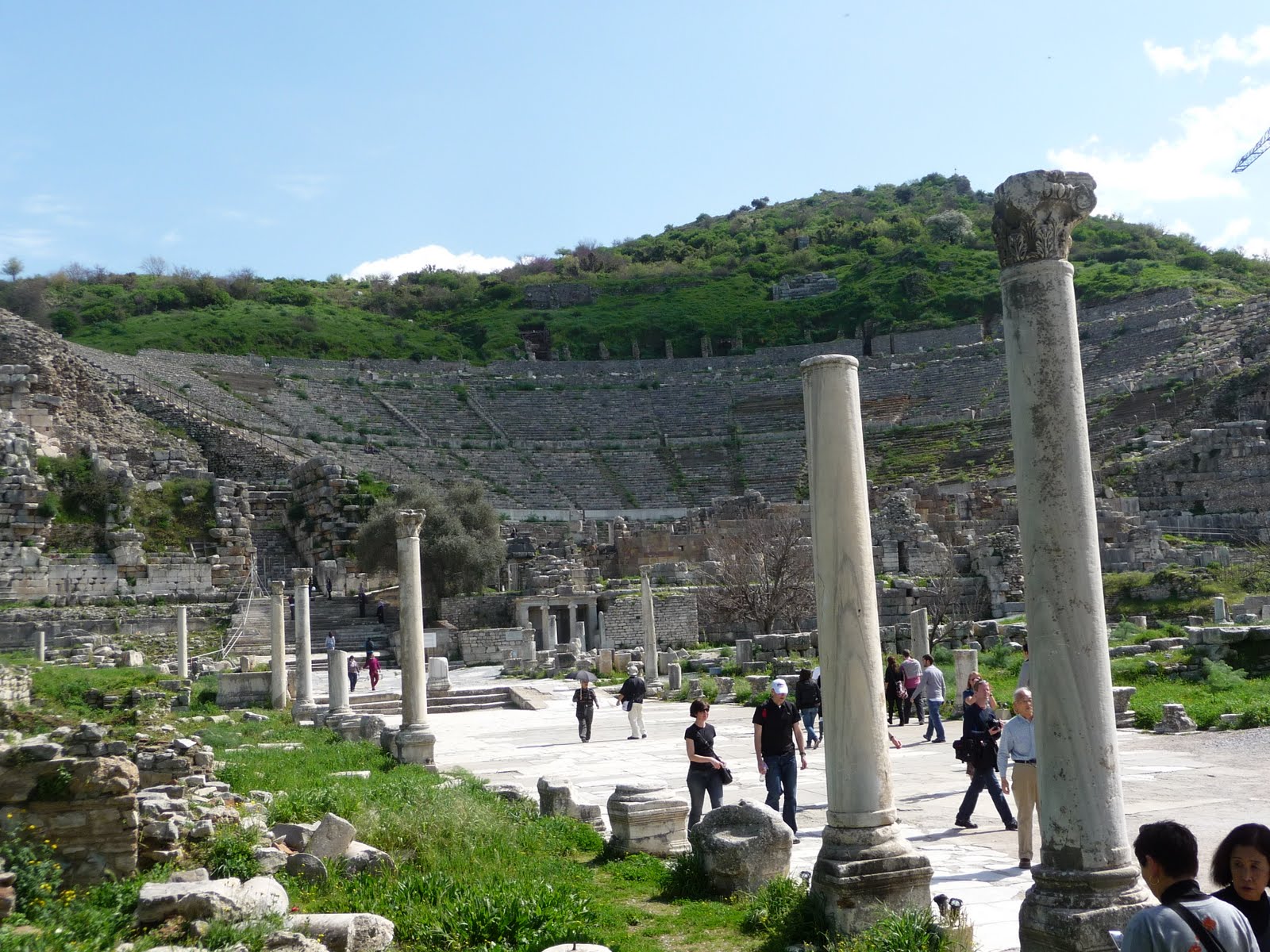
Last March, my wife and I had an opportunity to join an archaeological tour of Turkey with friends. We decided to visit Greece and Italy at the same time. We spent an entire month in this interconnected region.

Turkey and Greece have been assaulted by invading armies since the earliest recorded history. Even their legendary times, like the Trojan War, involved protracted military campaigns and sieges of impregnable fortresses.

Under Alexander the Great, the Greeks conquered Turkey, Persia  and most of the known world as far as India. A few centuries later, the Romans subjugated this region and built a world empire that lasted 700 years. After that, the Byzantine Empire ruled the Mediterranean region for nearly 1000 years.

From about 1400 to 1800, the Ottoman Turks dominated the entire Mediterranean region, and controlled much of Egypt, Arabia and parts of Europe. They became the most powerful empire on earth. Although Emperor Charles V was the most powerful ruler in Europe, he trembled at the military might of the Turkish Sultan. Fortunately for Charles, the reigning Sultan died right when the Turkish armies were poised to take Vienna and to sweep further into Europe.

At any given time, Turkey, Greece, and Italy were either ruling their neighbors or being ruled by them. And nowhere is this more evident than in the city of Istanbul, where our recent trip began. This city has been settled for at least 2,500 years, but it did not gain prominence until the Roman Emperor Constantine decided to make this city the new capital of the Roman Empire (which soon morphed into the Byzantine Empire). Constantine left Italy because Northern tribes were threatening to take Rome, which fell less than a century later. The Emperor Constantine named his city after himself: Constantinople. Later the city name changed to Byzantium and then finally to Istanbul.

There are many visible remnants of these ancient empires.  Museums overflow with statues, weapons, costumes, thrones, coins and sarcophagi commemorating ancient generals and kings. Ancient city ruins have been excavated and partly restored. Old stone roads that were built two thousand years ago still run through flourishing fields today. In Turkey, history lives visibly on.

Spiritual Conquerors
An entirely different type of conqueror also profoundly affected these Mediterranean lands. Small bands of unarmed travelers walked along Roman roads with an entirely different vision of conquest. I am talking about the first Christians who arrived in the First Century.  They sought to build an empire of the spirit. The evidence is hard to find at first glance. They left few objects to be found in museums nor did they build monuments. But in another sense, the evidence left by these spiritual conquerors is immense. 

Saul of Tarsus was the most notable early Christian missionary. He started his life as a devout Jew and rose to high leadership in that community. When Christians started attracting many Jewish followers, Saul led the movement to exterminate them completely. But on a trip to Damascus, where he planned to arrest and kill, Saul was struck down by an overpowering vision of Jesus speaking to him from Heaven. Within a few days, Saul was transformed and became Paul the devout Christian messenger.

Paul walked on endless Roman roads with Barnabas, Silas, Mark, and Timothy to found new churches throughout Turkey. Later, Paul and his companions moved on to Greece and Italy. Their intention was radically different from the plundering soldiers that lay waste every region they passed through. Instead of mass subjugation, these missionaries taught equality of all races, classes, and of male and female. They build new communities based on love and compassion, rather than on wealth and power.

Their teaching was deep love and compassion for all people: love for family, for neighbors, for strangers and for foreigners. Never before had such a compelling spiritual vision been offered with such great self sacrifice. These messengers were opposed, outlawed, tortured and killed in every city they visited. But still they marched on.

Leadership in early Christian communities was demonstrated by humility and by willingness to suffer.  The Apostle Paul wrote a letter to the church in Rome to explain his vision:

I consider that our present sufferings are not worth comparing with the glory that will be revealed in us...  No, in all these things we are more than conquerors through him who loved us.

 For I am convinced that neither death nor life, neither angels nor demons, neither the present nor the future, nor any powers, neither height nor depth, nor anything else in all creation, will be able to separate us from the love of God that is in Christ Jesus our Lord.

In today’s post-Christian world of Europe and North America, we forget how profoundly the Christian message changed history. It soon spread throughout Italy and prospered during the Dark Ages. St. Benedict built the first Italian monastery which we visited at Monte Cassino in the mountains of southern Italy. Other monasteries soon spread out from there.

Eventually, all of the pagan tribes of Europe were converted to Christianity. Obviously, “converted” is a relative term, since no tribe or nation has ever become fully “Christian”. Even today I wince at things said and done supposedly in the name of Christ.

But the transformation of Europe was unmistakable. Read Sir Arnold Toynbee’s Study of History and his analysis of all civilizations that have been known since recorded history began.  Though not a “Christian” himself, Sir Arnold credited Christianity with being the fundamental element of European Civilization. For centuries, this civilization was labeled “Christendom”.  Later it became known as “Western Civilization”, and now its law, economics, and social vision have swept over the whole world.

Western Civilization brought us our calendar, our legal system, our modern concept of morality, social justice, public service, and the equality of all races and gender. It inspired universities, built hospitals, and freed slaves. Though many scholars in the 21st Century consider Christianity obsolete, they forget what the world was like before it arrived.

I am not a Fundamentalist. I have high regard for other religious traditions. I believe in fresh spiritual insights for every century. But to deny our debt to these First Century Christian pioneers is unthinkable. Mahatma Gandhi, Albert Einstein, and the best thinkers of our planet have recognized the potency for societal transformation that Jesus inspired.

Obviously, many bad things have been done by people allegedly following Jesus Christ. But these so-called followers with their personal agendas of coercion can never offset the world transformation brought about by his sublime teaching.

By contrast, memories of the great Mediterranean kings have been mostly lost in the sands of time. We still see lovely statues, crowns, jewelery, and crumbling monuments built in their honour. But they didn’t fundamentally change history. People hardly remembered which marauding army had come through last. Their glory was in rampage, blood-lust, and plunder.  

The great English Romantic poet Percy Shelley wrote Ozymandias, which is about the futile poignancy of earthly conquest:
I met a traveler from an antique land
Who said: Two vast and trunkless legs of stone
Stand in the desert. Near them, on the sand,
Half sunk, a shattered visage lies, whose frown,
And wrinkled lip, and sneer of cold command,
Tell that its sculptor well those passions read
Which yet survive, stamped on these lifeless things,
The hand that mocked them, and the heart that fed;
And on the pedestal these words appear:
“My name is Ozymandias, king of kings:
Look upon my works, ye Mighty, and despair!”
Nothing beside remains. Round the decay
Of that colossal wreck, boundless and bare
The lone and level sands stretch far away.


Far better then generals or kings were those spiritual pilgrims who conquered their own minds, and who learned not to lose their temper. They helped gradually transform a violent society into one that is more gentle. These spiritual conquerors achieved the true immortality that former kings and emperors only dreamed of. They brought us a taste of the Kingdom of Heaven.

Monday, May 17, 2010

An Explainable Religious Faith

I have been traveling recently in Turkey, Greece and Italy. I heard many languages spoken. I saw evidence of religious faith in many places. I want to write a short explanation of my faith that could be understood by someone from a different culture and from another religious faith or perhaps no faith. So here are the main elements of what I believe:

I believe that it is very important to treat all people with the same love and respect that we show to our family and friends. We should treat neighbors and foreigners as we hope they will treat us.

That means forgiving others when they behave badly, loving difficult people, and having compassion for all people who are suffering. It means helping people in whatever way they urgently need to be helped.

It means treating everyone alike, whether they are male or female, young or old, rich or poor, educated or unschooled, of any religion or no religion. All people equally deserve my love and respect, no matter who they are.

Our natural tendency is to treat other people well only after they have demonstrated their good behaviour towards us. We tend to treat people well if they are already nice and friendly.

But that approach isn’t good enough to improve our world. Someone has to take the first initiative to offer goodwill whenever there is suspicion or hatred. To break the global curse of conflict and war, we must be willing to show love towards those who don’t (seem to) deserve it.

We need a higher moral and ethical standard than education, government or logic can produce in us. I believe that higher standard can only come through God’s inspiration.

Most people throughout the centuries have believed in God or in a Higher Power of some form. Regrettably, our human tendency is mostly to reject God’s wisdom. We would rather do everything our own way, even if it is wrong. Our unwillingness to listen God’s suggestions is the main cause of conflict and suffering.

There are many forms of religion in this world, but not all of them work equally well. I spent more than a decade investigating various religions, including Hinduism, Buddhism, Islam and Atheism. I have concluded that Jesus is the best guide to life. I have found no other faith teaching as helpful as his.

Jesus showed us how to find God’s wisdom and to follow it carefully. Unfortunately, many followers of Jesus do not imitate his life style. But whenever we practice his way of listening to God and loving everyone, we find new reason for hope. Jesus created a better world all around him by following God constantly. If we learn to listen intently to God, we will be inspired build a far better world around us.

Through Jesus, we see the face of God. It was for this reason that God sent Jesus to us. Jesus was willing to bet his life on his relationship with his Father God. Jesus died and returned to life to show us the potential for immortal life. That is our deepest longing: to live forever in a better place, on a higher plane.

I believe in miraculous events, but not in humans having magical powers. I see God doing astonishing things in my neighbourhood that you and I could never accomplish without Divine help.

I sense the Spirit of God participating in my daily life. In quiet moments I receive Spirit guidance for my challenges and my projects.

My faith affects everything I do and say. It changes who I am.

Not that I always get things right. I make many mistakes despite my belief in a higher standard. Often I don’t treat others with enough love and respect. But that doesn’t negate my faith.

I am on a long journey of learning: how to live and die, and how to find eternal life. My goal is to help bring a little bit of heaven down to earth. That is the Kingdom of God, the Kingdom of Heaven which Jesus demonstrated for us.